
Charlottesville Deed Records Lookup
Charlottesville deed records are maintained by the Charlottesville Circuit Court Clerk, the official recording authority for all real property instruments within this independent Virginia city. The clerk records property deeds, deeds of trust, plat and subdivision records, judgment liens, easement deeds, and related land instruments. You can search Charlottesville deed records through Virginia's free SRA online system or visit the courthouse in person for the grantor and grantee index, document viewing, and certified copy services.
Charlottesville Overview
Charlottesville Circuit Court Clerk
The Charlottesville Circuit Court Clerk's office records and indexes all land instruments for property within the city. Every deed, deed of trust, plat, judgment lien, and easement affecting Charlottesville real estate must be filed here. The clerk maintains deed books, a grantor and grantee index, and official plat files. Staff record new instruments, issue certified copies, and assist the public with index searches. For the current clerk contact information, address, and office hours, visit the Charlottesville Circuit Court page.
Charlottesville is home to the University of Virginia. The city's real estate market is active, with a steady volume of residential and commercial recordings. eRecording is widely used by title companies and settlement agents working in the area. The clerk's office is experienced with a range of instrument types, from basic warranty deeds to complex commercial financing documents.
The city operates its own circuit court separate from the surrounding Albemarle County. This is important to understand before you record or search. Property in Charlottesville city limits goes through the city clerk's office. Property in Albemarle County, even parcels just outside city lines, goes through the Albemarle County Circuit Court instead.
Searching Charlottesville Deed Records Online
Virginia's free SRA system is the primary online tool for searching Charlottesville land records. Select Charlottesville as the jurisdiction, then search by grantor name, grantee name, or date range. The SRA returns instrument type, recording date, and deed book and page number for each result. The index is free to search. Full document images may require a paid subscription through the SRA portal.
The grantor index lists instruments by the party who conveyed or released an interest. The grantee index lists instruments by the party who received an interest. A full title search typically runs both indexes to build a chain of ownership. Once you have a deed book and page reference, you can pull the document at the clerk's office or through the SRA portal.
In-person access is available at the Charlottesville courthouse during normal business hours. Public access terminals allow self-service index searches. Staff can help with older records not yet in the digital system. The Library of Virginia holds older Charlottesville deed books on microfilm and in digital collections, which is useful for chains of title predating electronic indexing.
What Gets Recorded in Charlottesville
The Charlottesville Circuit Court Clerk accepts all standard Virginia real property instruments. Warranty deeds transfer ownership with a guarantee of title. Quitclaim deeds convey whatever interest the grantor holds without that guarantee. Deeds of trust secure mortgage loans on city property. When loans are paid, a certificate of satisfaction is filed to release the lien. These are the most common instruments in the deed books.
Subdivision plats, condominium declarations, and boundary surveys are also filed here. Judgment liens and notices of lis pendens are recorded when they affect Charlottesville real estate. Easement deeds and powers of attorney for real estate transactions are accepted. Any instrument that creates, transfers, or modifies a real property interest in Charlottesville must be recorded to be legally effective against third parties.
Under Virginia Code § 55.1-407, Virginia follows a race-notice recording rule. An unrecorded deed can be defeated by a later buyer who records first without notice of the earlier transfer. In an active market like Charlottesville, recording promptly after settlement is essential. A delay creates a window of risk that title insurance and prompt recording both help address.
How to Record a Deed in Charlottesville
To record a deed in Charlottesville, submit the original signed and notarized document to the Circuit Court Clerk's office. The deed must meet Virginia's requirements under Virginia Code § 55.1-300 and Virginia Code § 17.1-252. Those requirements include legible text, proper margins, the grantor's and grantee's full names and addresses, a legal description of the property, and a notarized acknowledgment. The clerk reviews the document before accepting it.
Under Virginia Code § 17.1-227, the clerk must record any instrument that meets the statutory requirements when accompanied by proper payment. If the document does not meet requirements, it is returned with an explanation. Fix the defect and resubmit. There is no additional fee for a corrected resubmission.
eRecording is available in Charlottesville through approved vendors. This is the most common submission method for professional title companies operating in the area. Electronic submission is fast and typically processed the same day. For individuals recording outside a professional closing, in-person submission is the most direct approach.
Recording Fees and Taxes
Virginia sets recording fees on a statewide basis. Under Virginia Code § 17.1-275, an instrument of 10 pages or fewer costs $18 to record. Documents of 11 to 30 pages cost $32. Any instrument over 30 pages is $52. Copies of recorded instruments cost $0.50 per page. These amounts apply in Charlottesville just as they do everywhere in the state.
Most conveyances are subject to the grantor's tax. Virginia Code § 58.1-801 sets the rate at 25 cents per $100 of the consideration paid. Some transfers are exempt under Virginia Code § 58.1-811, including transfers between spouses, gifts to certain nonprofit organizations, and qualified business reorganizations. Your settlement agent will handle computing and collecting the correct taxes before closing.
Charlottesville vs. Albemarle County
This is the most common source of confusion when dealing with property in this area. Charlottesville is an independent city. It sits inside the geographic boundaries of Albemarle County, but it is not part of the county for legal or recording purposes. A parcel inside Charlottesville city limits has its chain of title at the Charlottesville Circuit Court. A parcel just outside city lines has its records at the Albemarle County Circuit Court. The two sets of deed books are completely separate.
Many properties carry a "Charlottesville" mailing address but are actually in Albemarle County. The city name in an address is not the same as the legal jurisdiction. Before searching or recording, confirm whether the parcel is inside the city or in the county. You can do this by checking the parcel's legal description or looking at city boundary maps. When there is any doubt, search both jurisdictions. The SRA system lets you select each court separately, so you can check both without significant extra effort.
Annexations over the years have moved some parcels from Albemarle County into Charlottesville. That can create situations where early deed records for a parcel are in the county books and later records are in the city books. If you are doing a long chain of title search in this area, check both sets of records for the relevant time periods.
Getting Copies of Charlottesville Deed Records
The Charlottesville Circuit Court Clerk provides copies through several channels. In person, you can visit the courthouse and request copies at the counter or use public access terminals. Staff will pull specific instruments by deed book and page number if you have that information. Copy fees are $0.50 per page. Certified copies require an additional certification fee and are appropriate when you need a legally authenticated document.
Mail requests are also available. Write to the clerk's office with the instrument details, your contact information, and a check for the estimated copy cost. Call first to confirm the fee. Include a self-addressed stamped envelope for the return of copies. The clerk's address is on the Charlottesville Circuit Court page.
For title searches, most professionals start with the SRA to identify relevant instruments by deed book and page, then request only the specific documents needed. That approach saves time and copy costs. The SRA index alone is often enough to confirm that a lien has been released or that a deed of trust is on file.
The image below is from the Charlottesville Circuit Court website, which provides current clerk details, hours, and recording procedures for the city.
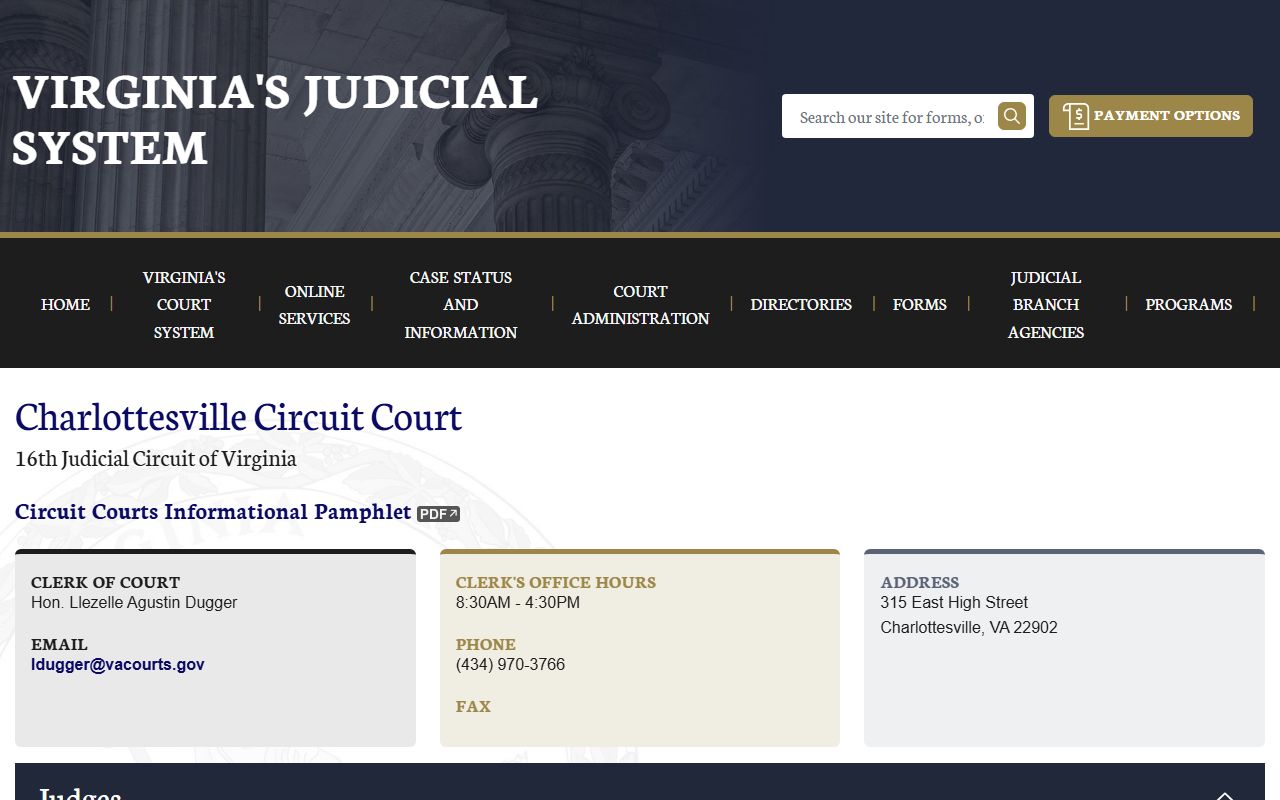
Check this page before visiting. The site is updated with any changes to recording hours or procedures and lists eRecording vendors approved for Charlottesville filings.
Nearby Cities
Charlottesville is surrounded by Albemarle County. Waynesboro is the nearest independent city with its own deed records. Property in the county is recorded at the Albemarle County Circuit Court.