
Virginia Deed Records
Virginia deed records are public land documents filed with the circuit court clerk in the county or city where the property sits. Each time a property changes hands, a deed gets recorded and becomes part of the permanent land record. You can use these records to find current and past owners, review deed of trust filings, check for liens, and trace the full chain of title on a piece of land. The Virginia Secure Remote Access system provides online access to land record indexes from participating clerk offices across the state.
Virginia Deed Records at a Glance
Where Virginia Deed Records Are Kept
The clerk of the circuit court is the official keeper of deed records in Virginia. Each of the state's 95 counties and 39 independent cities has its own clerk's office. That office records every deed, deed of trust, mortgage, quitclaim deed, easement, and plat filed in that jurisdiction. Under Virginia Code § 17.1-223, every writing authorized by law to be recorded must be accepted by the clerk upon payment of the applicable fees. Once recorded, the document becomes part of the permanent public land record.
Virginia's system is decentralized. There is no single statewide deed database that holds every filed document. Each clerk keeps the records for their own county or city. This means if you want deed records for a property in Fairfax County, you go to the Fairfax County Circuit Court Clerk. Property in the City of Richmond falls under the Richmond City Circuit Court Clerk. The Virginia Courts directory lists all 134 circuit court clerk offices with their contact information and links to local court websites.
Virginia Code § 17.1-227 sets out which documents must be recorded in the deed book. These include deeds, deeds of trust, releases, quitclaim deeds, grants, transfers, mortgages, powers of attorney to convey real estate, and leases, among others. Each instrument must be indexed under all party names as required by law.
The Virginia SRA system screenshot below shows the statewide land records portal, which provides index-only access at no charge for many participating clerks.
The Virginia Secure Remote Access portal is the main online gateway for land records statewide. This screenshot was taken from the SRA homepage, where users can search index data from participating court clerks.
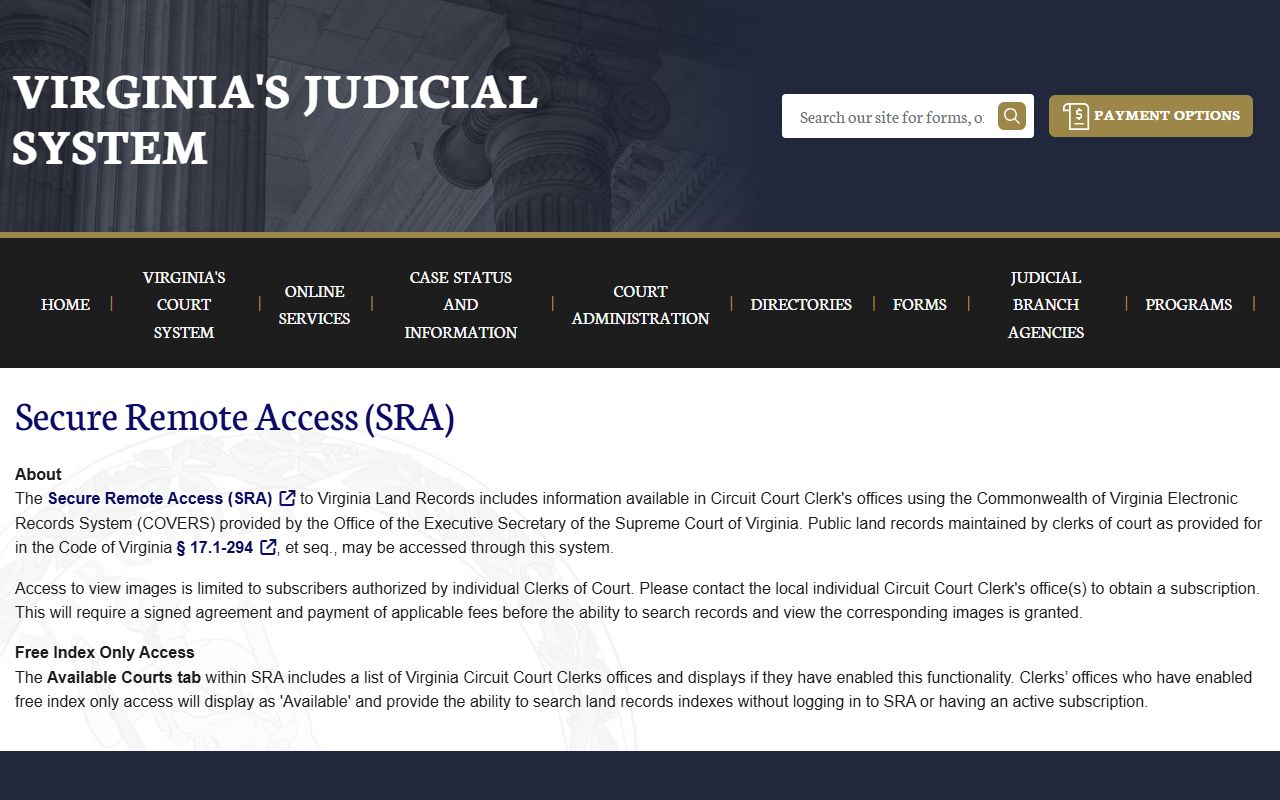
Free index-only access is available without a login for clerks who have enabled it. Full image access requires a paid subscription arranged through the local clerk's office.
How to Search Virginia Deed Records Online
The Virginia Secure Remote Access system, known as the SRA, is the official statewide online portal for land records. It is maintained by the Office of the Executive Secretary of the Supreme Court of Virginia and uses the Commonwealth of Virginia Electronic Records System (COVERS). Public land records maintained by clerks of court under Virginia Code § 17.1-294 et seq. may be accessed through this system.
Two access levels are available. Free index-only access lets you search the grantor and grantee indexes without logging in, as long as the local clerk has enabled this option. The Available Courts tab on the SRA site shows which clerks offer free index access. Subscription access gives you the ability to view actual document images. To get a subscription, you must contact the local circuit court clerk's office directly. That process requires a signed agreement and payment of applicable fees. Access is granted on a per-clerk basis, so a subscription with one clerk does not carry over to another.
To search, you generally need one of the following:
- The grantor name (seller or person conveying the property)
- The grantee name (buyer or recipient)
- An instrument number or deed book and page reference
- A date range to narrow results
The Virginia Court Case Information portal also provides access to some circuit court records. While it focuses on civil and criminal cases, it links to additional court services including the SRA. For attorneys and their staff, the Virginia Judiciary E-Filing System (VJEFS) allows electronic filing of civil cases and land records in participating courts.
The circuit courts directory connects users to each clerk's individual website. Many county clerks maintain their own online portals with land record search tools specific to their jurisdiction.
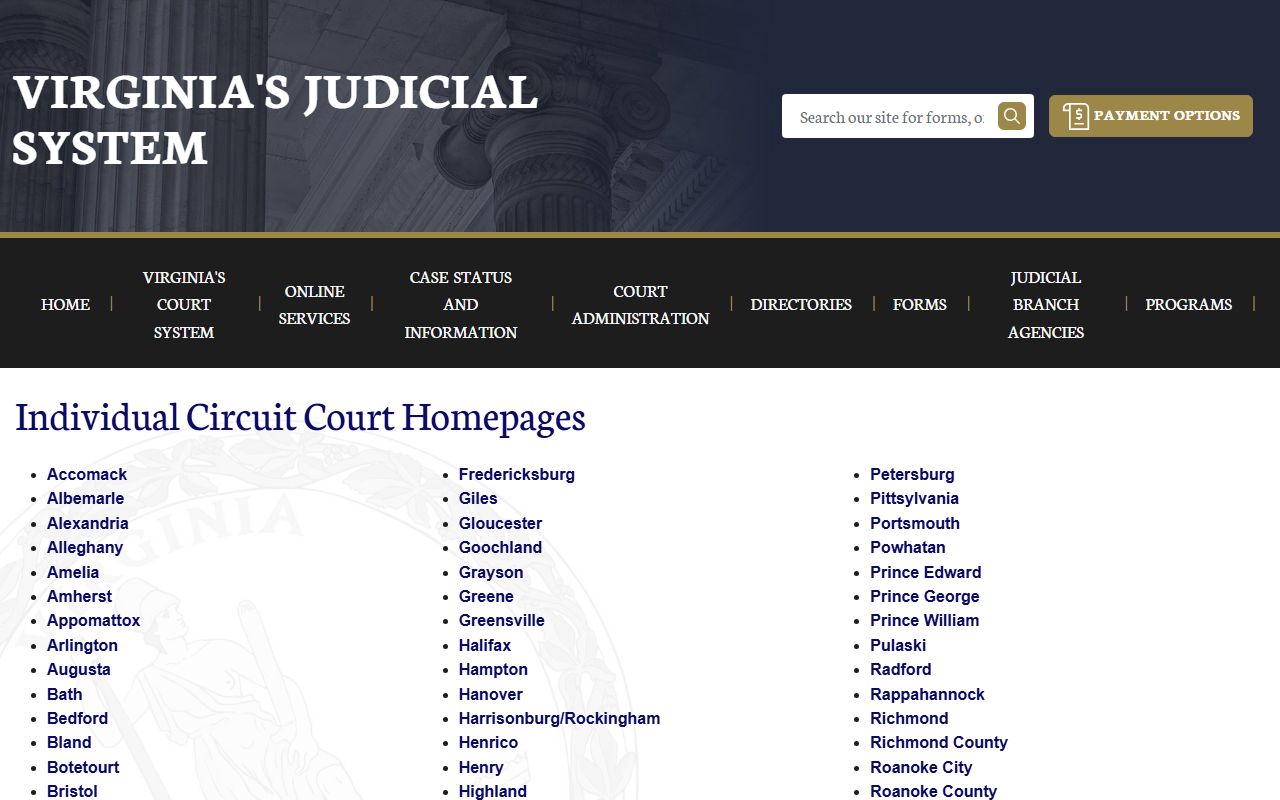
This directory page from the Virginia Courts website lists all circuit court clerks and their local resources. It is a useful starting point when you need to contact a specific clerk's office about deed records.
What Virginia Deed Records Contain
Virginia's deed books hold a wide range of real estate instruments. The most common is the warranty deed, which transfers title from one owner to another and includes the seller's guarantee of clear title. The form for a deed in Virginia is set out in Virginia Code § 55.1-300. Every deed must identify the grantor and grantee, describe the property, state the consideration, and be signed and notarized. Since July 1, 2020, no deed may reference specific portions of a restrictive covenant that restricts ownership based on a prohibited classification.
Quitclaim deeds transfer whatever interest the grantor holds without any warranty. They are often used between family members, in divorce settlements, or to clear up title defects. Deeds of trust are used instead of traditional mortgages in Virginia. A deed of trust conveys legal title to a trustee who holds it as security for a debt. The form for a deed of trust is found at Virginia Code § 55.1-316. When the debt is paid off, a certificate of satisfaction is recorded to release the lien.
Other documents recorded in the deed book include easement agreements, subdivision plats, condominium declarations, powers of attorney related to real estate, mechanic's lien filings, and notices of lis pendens. Each instrument must include the tax map reference number under Virginia Code § 17.1-252 in localities that maintain a parcel identification system.
Social security numbers must be removed from all documents before filing. Under Virginia Code § 17.1-227, the clerk will not knowingly accept any instrument that includes a social security number. The attorney or party who prepares the document is responsible for this step.
Recording Requirements in Virginia
Under Virginia Code § 55.1-600, a circuit court or its clerk shall record any writing when it has been properly acknowledged or proved before the clerk. Every document presented for recordation must be an original with original signatures. Copies are not accepted. Documents must also be properly notarized in accordance with Virginia law.
Most clerk offices require a land records cover sheet with every paper document submitted for recording. Under Virginia Code § 17.1-227.1, circuit court clerks may require that any deed or instrument affecting real property be submitted with a cover sheet. That cover sheet must include the names of all grantors and grantees, the amount of consideration and actual value of the property for tax purposes, any claimed tax exemption, the parcel identification number, and the return address for the document after recording. Some clerks have made cover sheets mandatory while others treat them as optional. Check with the specific clerk before submitting.
Pages must be numbered consecutively. The surname of each individual party must be underscored or written in all capital letters in the first clause of the instrument. For deeds, the consideration amount must be stated on the first page of the document itself, not only on the cover sheet.
Note: Failure to meet any of these requirements gives the clerk grounds to reject the document for recording. Correcting and resubmitting may cause delays in a real estate transaction.
Electronic recording is available in many Virginia counties and cities. Known as eRecording, this method allows title companies and law firms to submit land record documents electronically through approved vendors. Documents submitted by eRecording are returned to the filer immediately after recordation. A cover sheet is generally not required for electronically submitted documents.
The Library of Virginia sets standards for document formatting and margin requirements that apply statewide. The LVA also serves as the central repository for historical circuit court records transferred from local clerks, including older deed books and land records that have been microfilmed or digitized for preservation.
The Library of Virginia website at lva.virginia.gov provides access to digitized historical records, including deed books and land records going back to Virginia's earliest counties. This is a key resource for genealogical and historical research.
Virginia Deed Recording Fees
Recording fees in Virginia are set by Virginia Code § 17.1-275. The fee for recording and indexing an instrument is $18 for documents of 10 or fewer pages, $32 for documents of 11 to 30 pages, and $52 for documents of 31 or more pages. Of each recording fee collected, $3.50 goes toward preserving the permanent records of the circuit courts, administered by the Library of Virginia in cooperation with circuit court clerks.
Plat or map sheets no larger than 8.5 by 14 inches count as ordinary pages for recording fee purposes. Larger plat sheets carry a fee of $17 per page or sheet. For a certificate of satisfaction that releases the original deed of trust and any corrected or revised deeds of trust, only a single recording fee is charged regardless of how many instruments are released.
Copies of recorded documents cost $0.50 per page for standard copies or per image for electronic records. Certification adds an additional fee on top of the copy charge.
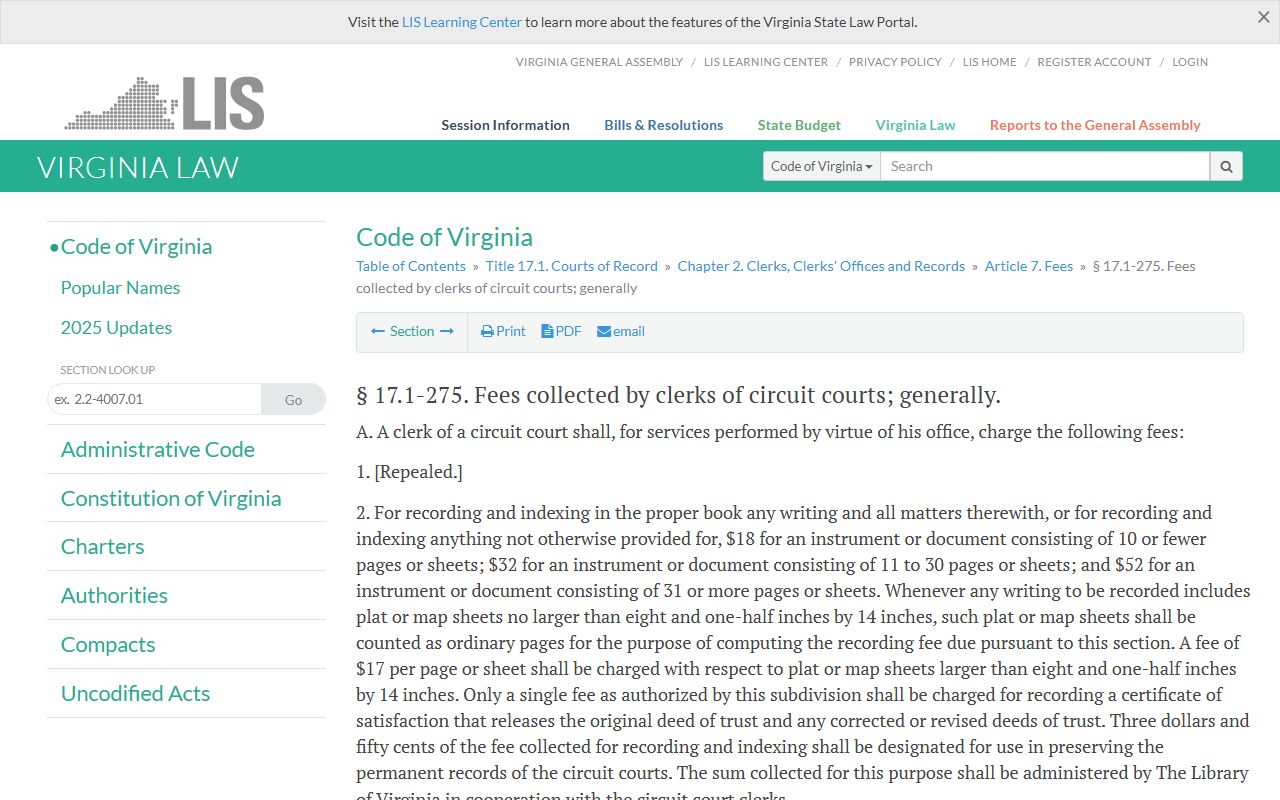
The fee statute shown here, Virginia Code § 17.1-275, sets the base recording fee schedule that all circuit court clerks in Virginia must follow. Fees are the same in every county and city under state law.
Virginia State Recordation Tax
In addition to recording fees, Virginia levies a state recordation tax on deeds under Virginia Code § 58.1-801. The rate is 25 cents for every $100 or fraction thereof of the consideration or the actual value of the property conveyed, whichever is greater. For purposes of this tax, actual value means the most recent property tax assessment at the time of conveyance. When the deed conveys property located partly in Virginia and partly outside the state, the tax applies only to the Virginia portion.
Many types of transfers are exempt from the state recordation tax under Virginia Code § 58.1-811. Exempt transfers include deeds to incorporated educational institutions, religious bodies, and government entities. Transfers in corporate mergers, between parent and subsidiary corporations, to revocable inter vivos trusts where the grantor and beneficiary are the same person, and deeds of partition among joint tenants or tenants in common are also exempt. Deeds transferring property as part of a divorce settlement are likewise exempt from the tax.
The Virginia Department of Taxation administers the state recordation tax rules and provides guidance on exemptions and calculations.
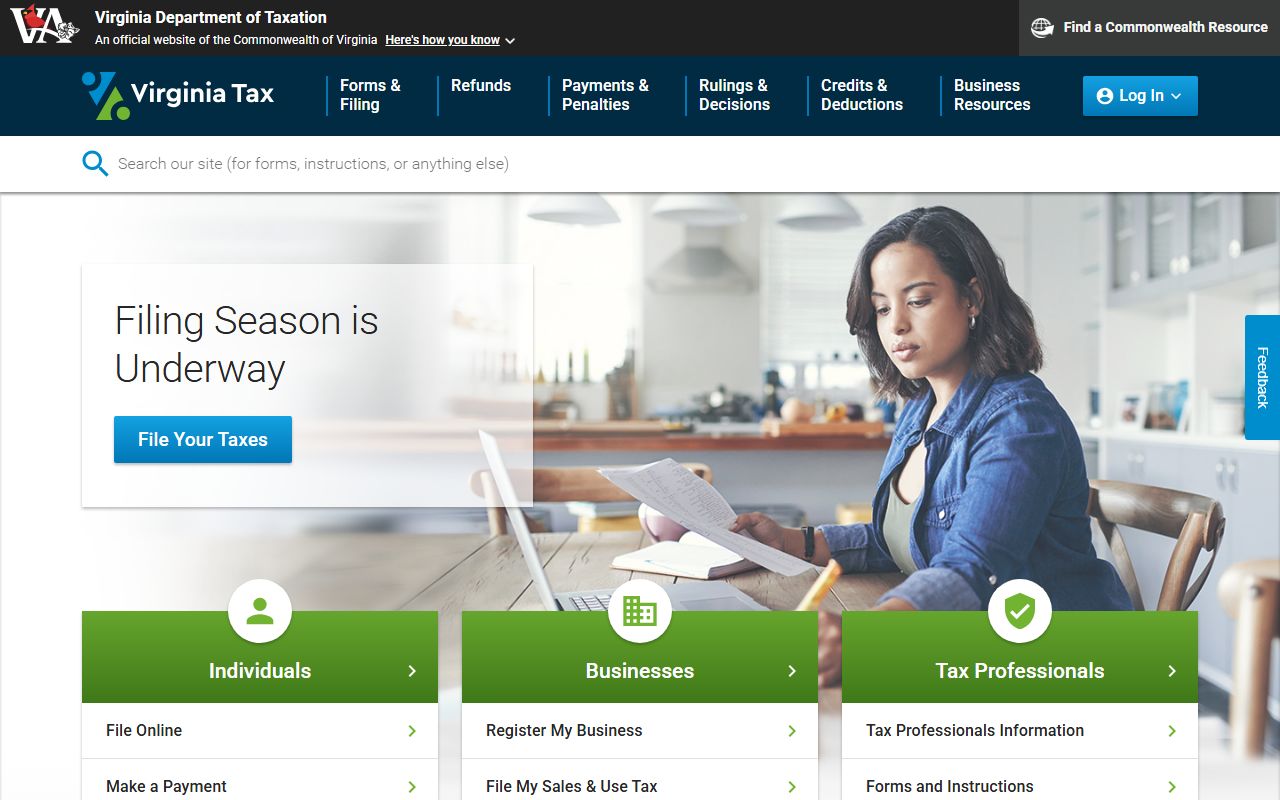
The Virginia Department of Taxation website at tax.virginia.gov has information on state recordation taxes that apply to deed filings, including guidance on which exemptions apply and how to calculate the correct tax amount.
Why Recording a Deed Matters
Virginia follows a race-notice recording system. Under Virginia Code § 55.1-407, every deed, contract, deed of trust, and mortgage is void as to all purchasers for valuable consideration without notice until it is recorded in the county or city where the property sits. In plain terms: if you buy a property but don't record your deed, someone else could record a competing claim first and win out in a dispute. Recording is what puts the world on notice that you own the property.
This is why title companies and real estate attorneys move fast to record deeds at closing. The clerk's office indexes each instrument in the daily index the same day it is recorded. Under Virginia Code § 17.1-249, that daily index must be transferred to the general index within 90 days. The general index is organized by grantor and grantee name, not by address. Title searches use these indexes to trace the full chain of title back through time.
Refinancing a mortgage works a bit differently. Under Virginia Code § 55.1-319, a subordinate mortgage keeps the same priority relative to a refinance mortgage as it had to the original, as long as the refinance meets specific criteria set out in the statute.
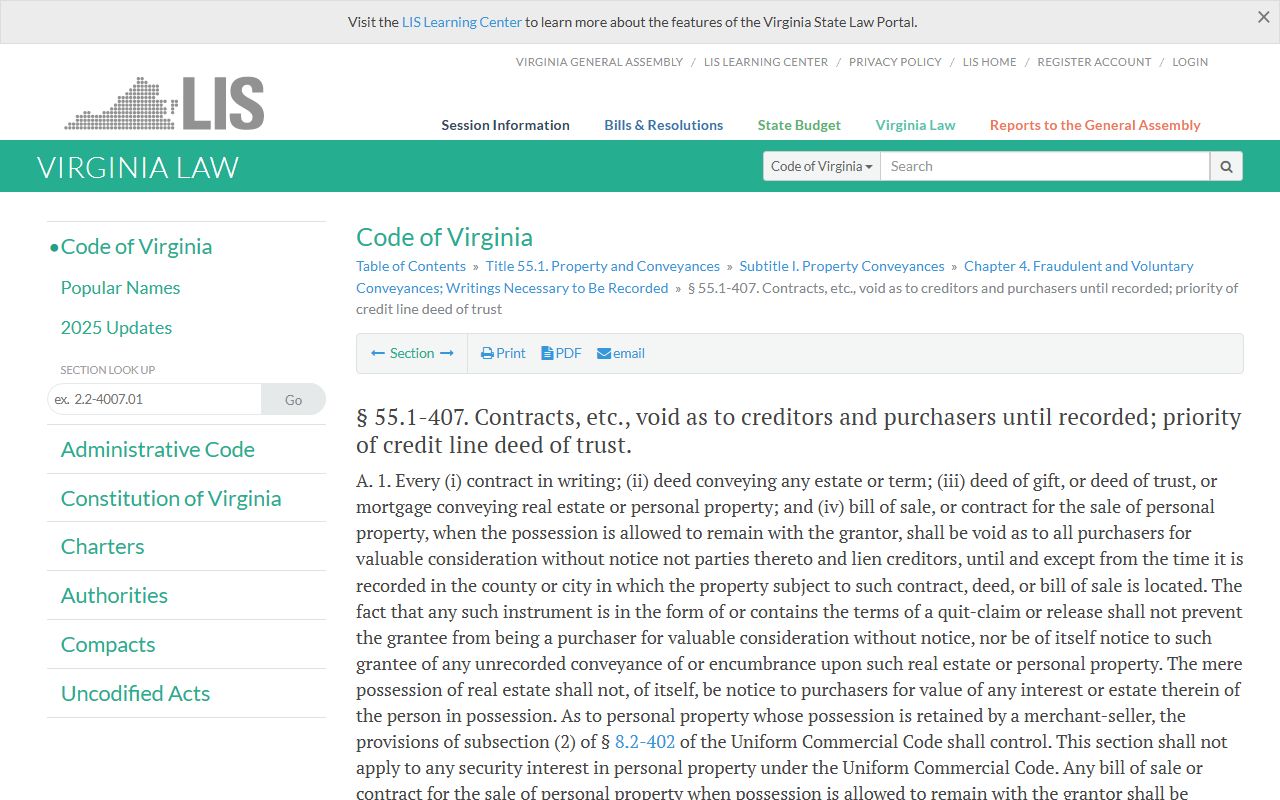
Virginia Code § 55.1-407, shown here at the Virginia Legislative Information System, establishes the race-notice rule that governs which recorded deed takes legal priority. Anyone dealing with real property in Virginia should understand how this statute works.
Related Virginia Land Record Resources
Deed records are just one part of the broader Virginia land record system. The Library of Virginia holds digitized deed books, will books, and land tax records from Virginia's earliest history through the 20th century. For many older counties, deed books have been scanned and are searchable on the LVA website for free. This is particularly useful for tracing historical title or doing genealogy research. The LVA also handles preservation of circuit court records that have been transferred from local clerks under state law.
The Virginia Department of Health Office of Vital Records is a separate resource that handles birth, death, marriage, and divorce records. These records do not show property ownership but can be useful alongside deed research when tracing estates or family property transfers across generations. The VDH office is located at 8701 Park Central Drive, Suite 100, Richmond, VA 23227, and can be reached at (804) 662-6200.
Virginia also uses the Commonwealth's property tax assessment system as a cross-reference. Tax records held by local assessors often parallel deed records and can help identify ownership dates, parcel identification numbers, and assessed values used in computing recordation taxes.
The Virginia Department of Health Vital Records office, shown here, maintains birth, death, marriage, and divorce records that can complement deed record research when tracing property ownership across generations or estates.
Browse Virginia Deed Records by County
Virginia's 95 counties each maintain their own deed records through the circuit court clerk. Click a county below to find the clerk's contact information, recording procedures, and resources for deed records in that area.
Deed Records in Virginia's Independent Cities
Virginia's 39 independent cities each have their own circuit court clerk who maintains deed records for property within city limits. Select a city below for deed records resources in that area.