
Norfolk City Deed Records
Norfolk deed records are maintained by the Norfolk City Circuit Court Clerk at 150 St. Paul's Boulevard, 7th Floor, Norfolk, VA 23510. The clerk records deeds, deeds of trust, plats, and other real estate instruments for all property inside Norfolk city limits. You can search land records in person during office hours, use the Virginia SRA system for online index access, or request certified copies by contacting the clerk's office directly. Norfolk is one of the largest independent cities in Virginia and part of the Hampton Roads metro area, with an active and well-organized land records system going back well over a century.
Norfolk Overview
Norfolk City Circuit Court Clerk
The Norfolk City Circuit Court Clerk's office is located at 150 St. Paul's Boulevard, 7th Floor, Norfolk, VA 23510. Phone: (757) 389-8942. The court serves the 4th Judicial Circuit. The court website is at vacourts.gov/courts/circuit/norfolk. Call the office to confirm current hours before visiting.
This office handles all land records for property inside Norfolk city limits. The clerk records deeds and related instruments, maintains the grantor and grantee index under Virginia Code § 17.1-252, issues certified copies, handles certificate of satisfaction filings when loans are paid off, and records judgment liens that affect real property. Norfolk is a large, active city with high recording volume, so the clerk's office processes a significant number of instruments each week.
Norfolk does not share its land records with any neighboring city. Chesapeake, Portsmouth, and Virginia Beach are each separate independent cities with their own circuit courts. If you are searching for property in one of those jurisdictions, you must contact their clerks' offices directly. The Norfolk City Circuit Court holds records only for parcels inside Norfolk city limits.
The grantor and grantee index is the core search tool for the clerk's system. Each recorded instrument gets an instrument number tied to the index. You can search by the property owner's name as grantor (seller or borrower) or grantee (buyer or lender) to trace ownership history and identify liens or encumbrances. Under § 17.1-252, this index must be kept current and accessible to the public at no cost.
The Norfolk City Circuit Court official page provides current office information, forms, and filing guidance for the clerk's office.
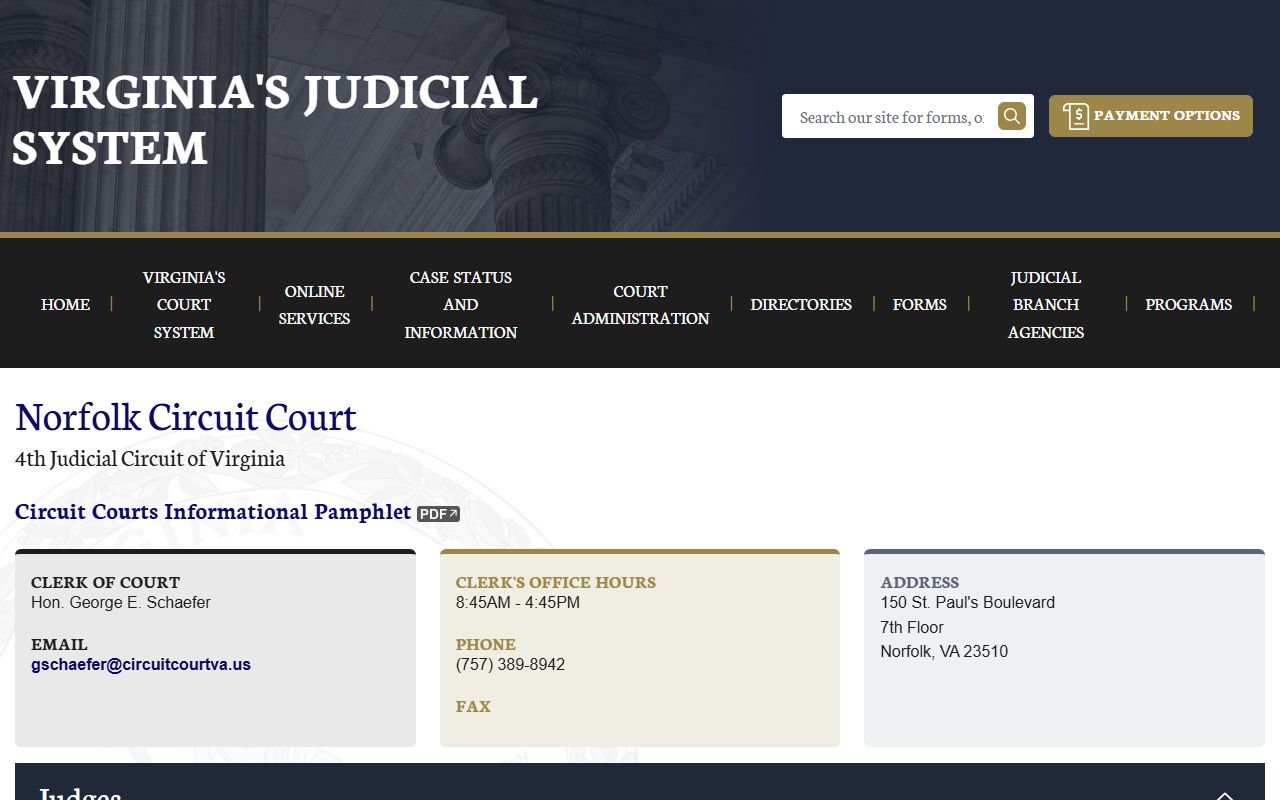
The court page is maintained by the Virginia Supreme Court system and reflects current staff, hours, and forms. Check it before visiting to confirm office hours and any changes to recording requirements.
Searching Norfolk Deed Records Online
The Virginia Supreme Court Records Access (SRA) system is the primary online tool for searching Norfolk deed records. SRA provides access to grantor and grantee indexes. You can search by party name, find instrument numbers and recording dates, and identify document types without visiting the courthouse. SRA covers all Virginia circuit courts and is updated as new instruments are recorded.
SRA offers free and subscription-based access. Free searches let you look up index entries and confirm recording status. A subscription gives access to more detailed information. For most basic lookups, free access is sufficient to identify instruments and recording dates before deciding whether to request copies.
In-person research at the Norfolk courthouse gives you direct access to deed books, plat books, and microfilm for older records. The clerk's office has public access terminals for index searches. Staff can help navigate the indexes and locate physical deed books. Plain copies cost $0.50 per page and are available at the counter. Certified copies cost $0.50 per page plus a $2.00 certification fee per document.
The Library of Virginia holds historical land records from Norfolk and other Virginia localities. For deep historical title research or records that predate the modern indexing system, LVA's collections are a strong supplemental resource. Their materials are free to access and include microfilm and digitized deed books going back centuries.
What Gets Recorded in Norfolk
The Norfolk City Circuit Court records a broad range of real estate instruments. Common types include warranty deeds, special warranty deeds, and quitclaim deeds that transfer ownership of residential, commercial, and industrial property inside city limits. Deeds of trust and mortgage instruments secure loans against real property and are recorded at the time of purchase or refinancing.
Other recorded instruments include certificates of satisfaction when loans are paid off and the deed of trust is released, easements and rights-of-way that affect use and access to property, subdivision plats that establish lot lines and street dedications, and powers of attorney used in real estate transactions. Judgment liens recorded against property owners are also part of the land records system and appear in the grantor index.
Under Virginia Code § 55.1-407, any recorded instrument is constructive notice to all future purchasers and lenders from the date of recording. A buyer or lender who does not search the records is still assumed by law to know what they contain. This rule makes a complete title search essential before any property transaction closes in Norfolk.
How to Record a Deed in Norfolk
To record a deed in Norfolk, bring the original signed and notarized document to the clerk's office at 150 St. Paul's Boulevard, 7th Floor. All documents are reviewed for compliance before recording. Documents that do not meet Virginia's requirements are returned, which can delay closing timelines.
Required elements: original signatures (no photocopies, faxes, or digital reproductions), proper notarization with a valid notary seal and signature, a full legal description of the property, the preparer's name and address on the document, and removal of Social Security numbers before submission under Virginia Code § 17.1-227. The deed must comply with general conveyancing standards under Virginia Code § 55.1-300, including proper identification of the grantor and grantee.
The consideration paid must be stated in the document, or the applicable tax exemption must be cited under Virginia Code § 58.1-811. Recording fees and transfer taxes are due at the time of recording. The clerk will not record any document without full payment. Review the document carefully before submitting. Errors in party names, legal descriptions, or notarization are the most common causes of rejection.
Recording Fees and Taxes
Recording fees in Norfolk follow the statewide schedule set by Virginia Code § 17.1-275. The base fee is $18 for documents of 10 pages or fewer. Documents of 11 to 30 pages cost $32. Documents of 31 or more pages cost $52. These amounts cover standard deed recordings. Certain document types may carry additional fee items beyond the base recording fee.
The Virginia real property transfer tax applies to most deed conveyances. Under Virginia Code § 58.1-801, the rate is $0.25 per $100 of the consideration or fair market value of the property. Some transactions qualify for exemptions or reduced rates under Virginia Code § 58.1-811, including transfers between spouses, gifts of property, and certain corrective deeds. Any claimed exemption must be cited by code section in the document itself.
Both fees are due at the time of recording. Confirm exact amounts with the clerk's office before visiting. Payments are typically made by check or money order payable to the circuit court clerk. Ask about accepted payment forms in advance, especially for larger transactions involving multiple instruments.
Norfolk Land Records History
Norfolk has one of the oldest and most extensive land records systems in Virginia. The city's deed books go back to the seventeenth century, reflecting Norfolk's long history as one of Virginia's most important port cities. These older records are particularly valuable for historical title research and genealogical work tied to property ownership.
The Library of Virginia holds microfilm and digitized copies of historical Norfolk deed books. For research covering periods before the circuit court's current electronic indexing, LVA's collections are an essential resource. Many older deed books are indexed by name in LVA's finding aids, making it possible to trace ownership chains going back hundreds of years.
The Norfolk City Circuit Court's modern records are indexed through SRA and are accessible online for instruments recorded in recent decades. For instruments recorded before electronic indexing, in-person research or microfilm review may be necessary. The clerk's staff can help you identify which deed books cover a given time period and how to navigate the older indexes.
Getting Copies of Norfolk Deed Records
Norfolk deed records are public records. No ownership interest or legal standing is required to search or copy them. Access is open to the public during business hours at 150 St. Paul's Boulevard, 7th Floor.
Plain copies are $0.50 per page and are available at the clerk's counter. For legal, title insurance, or lender purposes, certified copies are required. Certified copies carry the clerk's seal and official signature. They cost $0.50 per page plus a $2.00 certification fee per document. The clerk issues certified copies the same day for documents available in the office.
For mail requests, send a written request to the Norfolk City Circuit Court Clerk at 150 St. Paul's Boulevard, 7th Floor, Norfolk, VA 23510. Include the instrument number or full party names and recording date range, along with payment for the fees. Call (757) 389-8942 first to confirm current procedures and accepted payment methods. Mail turnaround varies by request volume.
The SRA system is the best starting point for identifying instruments before requesting copies. Using SRA to confirm the instrument number makes any follow-up request faster and more accurate, whether by mail or in person.
Nearby Cities
Norfolk is surrounded by other independent cities in the Hampton Roads region. Each has its own circuit court and maintains separate deed records. Property just outside Norfolk city limits may fall in one of these jurisdictions.