
Hampton City Deed Records
Hampton deed records are maintained by the City of Hampton Circuit Court Clerk, the office responsible for recording all real property instruments within the independent city. Hampton is one of Virginia's larger independent cities, located in the Hampton Roads region on the lower Virginia Peninsula. Deeds, deeds of trust, easements, subdivision plats, and all other instruments affecting Hampton property are filed with the city's own circuit court clerk rather than any county office. You can search the land record index online through Virginia's SRA system or visit the clerk's office in person at the Hampton courthouse.
Hampton Overview
Hampton Circuit Court Clerk
The Hampton Circuit Court Clerk's office is located at 101 Kings Way, Hampton, VA 23669. The clerk records all land instruments for property within the City of Hampton. The office is open Monday through Friday. You can reach the clerk by calling 757-727-6105. Confirm current hours before visiting, as holiday and closure schedules vary.
Hampton accepts walk-in deed submissions, mail-in recordings, and eRecording through approved vendors. eRecording is widely used by Hampton Roads title companies because it allows same-day recording without a courier. If you use a title company for a Hampton closing, ask whether they are set up for eRecording through the Hampton clerk's office.
Public access terminals at the courthouse allow you to search the land record index and view document images during business hours. Staff can assist with specific instrument lookups, searches for older deed books, and requests for certified copies. For complex title research, the clerk's office staff can help you navigate the deed books going back many decades.
More information about the court and clerk's office is available on the Hampton Circuit Court website.
Searching Hampton Deed Records Online
Virginia's free SRA system provides access to the Hampton grantor and grantee index. Enter a property owner's name or use a date range to find instruments recorded during a given period. The index shows the instrument type, recording date, deed book number, and page number for each entry. This is the starting point for most Hampton deed searches.
Full document images through the SRA system may require a fee for some records, but the index is free. For in-person research, the public terminals at the Hampton Courthouse let you view deed images at no extra charge during business hours. Older deed books that predate electronic indexing are available for research at the clerk's office as well.
The Library of Virginia holds historical Hampton land records and the older Elizabeth City County deed books. Because Hampton was formed through the merger of Elizabeth City County and the old city of Hampton in 1952, the LVA's collections cover the predecessor jurisdictions. For chain of title research going back before 1952, you will need to search the Elizabeth City County deed books at the LVA.
Hampton's active real estate market and the large number of deeds on file make the SRA index and clerk's terminals the most practical research tools for current and recent transactions.
What Gets Recorded in Hampton
The Hampton clerk records all standard real property instruments for city properties. Common types include warranty deeds, special warranty deeds, quitclaim deeds, deeds of gift, deeds of trust and deeds of release or satisfaction, easements, subdivision plats, condominium declarations, powers of attorney used in real estate transactions, judgment liens, and lis pendens notices.
Virginia is a race-notice state under Virginia Code § 55.1-407. A buyer who records a deed first, without notice of an earlier unrecorded transfer, can take priority over that earlier deed. In Hampton's active real estate market, same-day recording after closing is the norm. Title insurance companies require it, and lenders expect it. Recording delays create real legal risk.
Subdivision plats filed with the Hampton clerk define lot lines, easements, setback lines, and the layout of recorded subdivisions. Any title search that involves a subdivided lot should include a review of the relevant plat. Legal descriptions in Hampton deeds often refer to plat book and page numbers.
How to Record a Deed in Hampton
To record a deed covering Hampton city property, submit it to the Hampton Circuit Court Clerk. The instrument must comply with the form requirements under Virginia Code § 55.1-300. It must be signed by the grantor, acknowledged before a notary public, name both grantor and grantee, include a property description sufficient to identify the parcel, and state the consideration paid or the basis for the transfer.
The tax map reference number for the parcel must appear on the first page of every deed under Virginia Code § 17.1-252. This number comes from the Hampton real estate assessor's records and links the instrument to the city's parcel database. The clerk will not record a deed that is missing this number.
Every instrument submitted for recording must be accompanied by a cover sheet as required by Virginia Code § 17.1-227. The cover sheet captures the party names, instrument type, and property information. It also provides a mechanism for SSN redaction if the document contains a Social Security number. Documents must be typed or clearly printed, at minimum 8-point font, on paper no larger than 8.5 by 14 inches.
Recording Fees and Taxes in Hampton
Virginia's recording fee schedule is fixed by Virginia Code § 17.1-275. The fee is $18 for instruments of 10 pages or fewer. Instruments of 11 to 30 pages cost $32. Deeds or other instruments over 30 pages cost $52. These rates apply to the Hampton clerk the same as all other Virginia circuit court clerks.
The state recordation tax is set by Virginia Code § 58.1-801 at 25 cents per $100 of the consideration. Some Virginia localities levy an additional local grantor's tax on top of the state rate. Check with the Hampton clerk's office about any local charges that apply to Hampton property transfers.
Some transfers qualify for recordation tax exemptions under Virginia Code § 58.1-811. Transfers between spouses, certain nonprofit and government transfers, and some business reorganization transfers may be exempt. The exemption must be stated on the instrument or the cover sheet. The clerk collects the full tax if no exemption is claimed.
Hampton Land Records History
The modern City of Hampton was created in 1952 through the merger of the former independent city of Hampton and Elizabeth City County. Before 1952, land records for the area were maintained separately by the county and by the original city. The deed books from Elizabeth City County are now held at the Library of Virginia, which makes the LVA an important resource for historical title research on Hampton properties.
Post-1952 records are maintained by the current Hampton Circuit Court Clerk's office. The deed books from the merger period forward are indexed in the same system as current recordings. Title researchers tracing a long chain of title should plan to review both the pre-1952 county and city deed books at the LVA and the post-1952 Hampton clerk records.
Getting Copies of Hampton Deed Records
Copies of Hampton deed records are available from the Hampton Circuit Court Clerk at 101 Kings Way. Standard copies are $0.50 per page. Certified copies carry an additional fee and are sometimes needed for legal proceedings or refinance transactions.
You can request copies in person during business hours or by mail. For mail requests, include the deed book and page number or the instrument number, the names of the parties, and the recording date. Send a check payable to the Clerk of the Circuit Court along with a self-addressed stamped envelope.
The image below is from the Hampton Circuit Court website, showing the clerk's office resources for deed recording and research in the city.
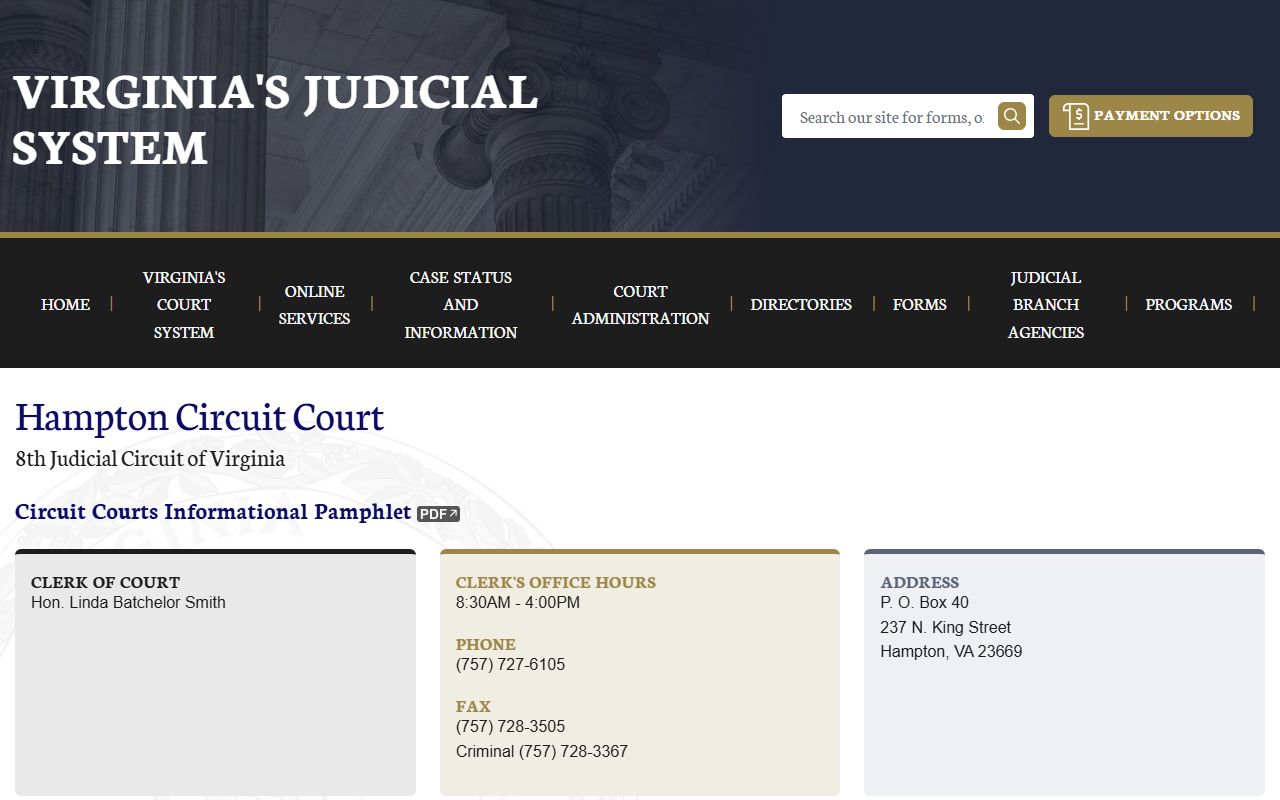
The Hampton Circuit Court Clerk at 101 Kings Way is where all deeds and land instruments for Hampton city properties are recorded and indexed.
Nearby Cities
Hampton is part of the Hampton Roads metro area, surrounded by several other independent cities that each maintain their own deed record offices.