
Search Chesapeake Deed Records
Chesapeake deed records are filed with the Chesapeake Circuit Court Clerk, the official recording office for all land instruments within this large independent city in southeastern Virginia. The clerk records property deeds, deeds of trust and mortgage instruments, plat and subdivision records, judgment liens, and other documents affecting real estate in the city. You can search Chesapeake deed records through Virginia's free SRA online index or visit the courthouse in person for direct access, document copies, and certified record services.
Chesapeake Overview
Chesapeake Circuit Court Clerk
The Chesapeake Circuit Court is part of the 1st Judicial Circuit. The clerk's office is the sole recording authority for land instruments within Chesapeake city limits. Every deed, deed of trust, plat, lien, and easement affecting Chesapeake real estate must be filed here. The clerk maintains deed books, a grantor and grantee index, and plat files for the city. Staff handle new recordings, certified copy requests, and public index searches. For the current address, phone, and hours, visit the Chesapeake Circuit Court page.
Chesapeake is one of Virginia's largest cities by land area. The real estate market is active, with a high volume of residential and commercial recordings. eRecording is available and widely used by settlement agents and title companies. Using eRecording avoids the need for in-person submission and typically speeds up processing. Check the court's website for approved eRecording vendors.
Because recording volume is high, the clerk's office processes documents efficiently. Staff are experienced with complex instrument types, including commercial financing packages with multiple exhibits. If you have a large or complex filing, calling ahead to discuss requirements can save time.
Searching Chesapeake Deed Records Online
Virginia's free SRA system is the primary online tool for searching Chesapeake land records. Select Chesapeake as the jurisdiction, then search by grantor name, grantee name, or recording date. Results show instrument type, recording date, and the deed book and page number. The index is free to search. Full document images may require a paid subscription through the SRA portal.
For title searches, grantor and grantee searches are run together to build a complete chain of title. The grantor index shows instruments where a party conveyed or released a property interest. The grantee index shows instruments where a party received an interest. Once you have the deed book and page reference, you can pull the actual document at the courthouse or through SRA's document viewer.
In-person access is available at the Chesapeake courthouse. Public access terminals allow self-service index searches during business hours. Staff can assist with older records, deed book lookups, and certified copy requests. Copies are $0.50 per page. For very old records predating electronic indexing, the Library of Virginia holds historical deed books from Chesapeake and its predecessor jurisdiction, Norfolk County.
What Gets Recorded in Chesapeake
The Chesapeake Circuit Court Clerk records all standard Virginia real property instruments. Warranty deeds transfer ownership of residential and commercial property. Quitclaim deeds convey the grantor's interest without warranty. Deeds of trust secure mortgage loans. Certificates of satisfaction release deeds of trust when loans are paid off. All of these go into the permanent deed books. Plat records and subdivision maps are filed here and show how parcels are divided and how easements and rights-of-way are laid out.
Judgment liens attach to real property when a court enters a money judgment. Notices of lis pendens notify the public that litigation is pending that may affect title. Easement deeds, condominium declarations, and powers of attorney for real estate are also recorded. Any instrument that creates, transfers, or releases an interest in Chesapeake real estate belongs in these deed books to be effective against third parties.
Under Virginia Code § 55.1-407, Virginia follows a race-notice recording rule. A deed that is not recorded can be defeated by a later buyer who records first without prior notice of the earlier deed. In a large, active city like Chesapeake, recording immediately after settlement is standard practice. Even a short delay creates a gap in the chain of title that can create problems later.
How to Record a Deed in Chesapeake
To record a deed in Chesapeake, submit the original signed and notarized document to the Circuit Court Clerk's office. The deed must meet Virginia's requirements under Virginia Code § 55.1-300 and Virginia Code § 17.1-252. Requirements include legible text, proper margins, the grantor's and grantee's names and addresses, a legal description of the property, and a notarized acknowledgment. The clerk reviews the document before accepting it for recording.
Under Virginia Code § 17.1-227, the clerk must record any instrument that meets the requirements and is accompanied by proper fees. Documents that do not meet requirements are returned with an explanation. Corrected documents can be resubmitted without an additional filing fee. Most title professionals use a checklist before submission to avoid common defects like missing notary information or incorrect margins.
eRecording is common in Chesapeake for professional submissions. Settlement agents and title companies typically use eRecording vendors to submit deeds and deeds of trust the same day as closing. For individuals recording documents outside of a professional settlement, in-person or mail submission works fine. Call or check the court website to confirm the current submission options and hours.
Recording Fees and Taxes
Virginia's statewide recording fee schedule applies in Chesapeake. Under Virginia Code § 17.1-275, an instrument of 10 pages or fewer costs $18 to record. Documents of 11 to 30 pages cost $32. Any instrument over 30 pages is $52. Copies of recorded instruments are $0.50 per page. These fees apply uniformly across all Virginia circuit courts.
Most conveyances trigger the grantor's tax. Virginia Code § 58.1-801 sets the rate at 25 cents per $100 of the sale price. Certain transfers qualify for exemptions under Virginia Code § 58.1-811. Common exemptions include transfers between spouses, certain charitable transfers, and qualified corporate reorganizations. Your settlement agent will calculate and collect all taxes and fees at closing.
Chesapeake Land Records
Chesapeake was formed in 1963 when the city of South Norfolk merged with Norfolk County. Prior to 1963, land records for what is now Chesapeake were held in the Norfolk County deed books. Those older records are available at the Library of Virginia. Chesapeake's own deed books begin at the city's formation and run continuously to the present day. If you are tracing a chain of title that goes back before 1963, start with the SRA for records after that date, then move to the LVA for the Norfolk County period.
The city's large land area includes a mix of suburban neighborhoods, rural tracts, and commercial corridors. Title searches in Chesapeake sometimes involve large parcels with complex descriptions. Subdivision plats are an important part of this record set, as many Chesapeake neighborhoods were created through recorded plats that establish lot boundaries and easements. Plat books at the clerk's office and the SRA system cover these records.
Getting Copies of Chesapeake Deed Records
The Chesapeake Circuit Court Clerk provides copies in several ways. In person, you can visit the courthouse, use public access terminals to find instruments, and request copies at the counter. Copy fees are $0.50 per page. Certified copies cost more and are appropriate when you need a legally authenticated document for court, lending, or title purposes.
Mail requests are accepted. Write to the clerk's office with the deed book and page number or other identifying information, your contact details, and a check for the copy fee. Call the office to confirm the exact fee before mailing payment. Include a self-addressed stamped envelope to receive copies by return mail. The current mailing address is on the Chesapeake Circuit Court page.
For large title searches, most professionals use the SRA to identify relevant documents by book and page, then request only the specific instruments they need. That is faster and less expensive than ordering blanket sets of records. The SRA index search alone often answers basic questions about whether a deed or release is on file.
The image below is from the Chesapeake Circuit Court website, which provides current clerk contact details and recording information for the city.
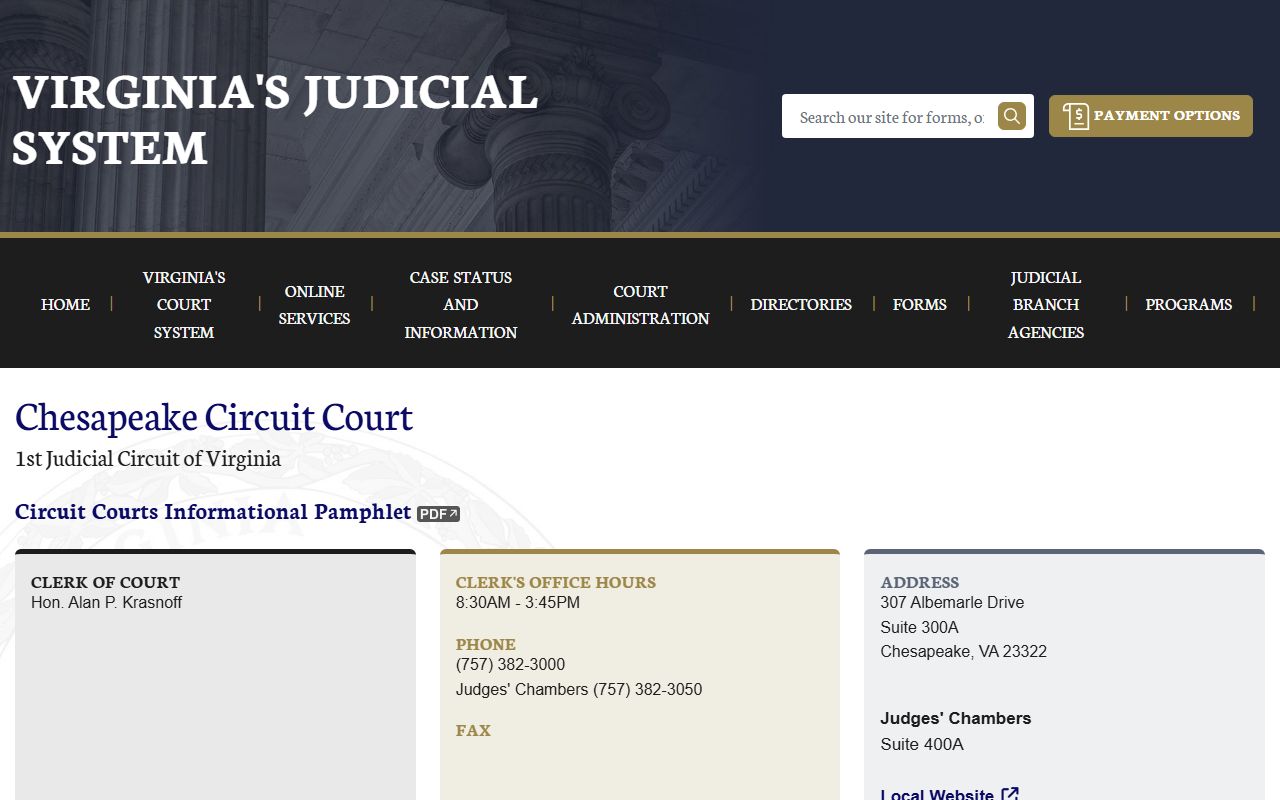
Check this page before visiting. Hours and any changes to recording procedures are listed there. The site also links to eRecording vendors approved for Chesapeake filings.
Nearby Cities
Chesapeake borders several major Hampton Roads independent cities. Each has its own circuit court clerk for deed recording.