
Suffolk City Deed Records
Suffolk deed records are maintained by the Suffolk City Circuit Court Clerk, the official recording office for all real property instruments within Suffolk's independent city limits. Suffolk is one of the largest cities in Virginia by land area and is part of the Hampton Roads region. All deeds, deeds of trust, plats, and related instruments for property within Suffolk city limits must be filed with this office. You can search Suffolk deed records online through the Virginia SRA system, visit the clerk's office in person, or request copies by mail.
Suffolk Overview
Suffolk City Circuit Court Clerk
The Suffolk City Circuit Court Clerk is the recording officer for real estate instruments in Suffolk. The clerk's office maintains the grantor and grantee index, assigns instrument numbers to each recorded document, and keeps the official deed books for the city. The Suffolk City Circuit Court website provides current contact information, office hours, and staff details. Confirm hours before visiting, as court events and holidays can affect access.
Suffolk is an independent city and does not share its land records system with any neighboring jurisdiction. Chesapeake, Portsmouth, Norfolk, and the surrounding counties each have their own circuit court clerks and maintain their own deed records. Any deed for property within Suffolk city limits must be filed with the Suffolk City Circuit Court Clerk. This is true even for rural areas of the city that may seem distant from downtown Suffolk. Suffolk covers a large geographic area, but jurisdiction follows city limits, not proximity to the courthouse.
The clerk's office handles deed recording, deed of trust releases, plat filings, judgment liens, easements, and other instruments affecting real property in the city. Staff can assist with locating records, pulling deed books, and guiding researchers through the index system. For complex title research, SRA is the typical starting point, followed by an in-person visit or copy request for specific documents.
Searching Suffolk Deed Records Online
The Virginia Supreme Court Records Access (SRA) system is the primary online tool for searching Suffolk deed records. SRA gives access to the grantor and grantee index. Search by party name to find instrument numbers, recording dates, and document types. Free access is available for basic searches. Subscription access provides broader retrieval and more historical index coverage.
SRA shows index data. For full document text, including legal descriptions and deed of trust terms, you need copies from the clerk or an in-person visit to review the deed books directly. Most researchers use SRA to identify relevant instruments and then follow up for copies of the ones they need to review in detail.
In-person research at the Suffolk courthouse gives you access to deed books, plat books, and index volumes. Public access terminals are available during business hours. Staff can assist with finding records and understanding the index structure. Plain copies cost $0.50 per page. Certified copies are $0.50 per page plus a $2.00 certification fee per document and carry the clerk's seal for legal and lending use.
What Gets Recorded in Suffolk
The Suffolk City Circuit Court records all instruments that affect title to real property within city limits. Ownership transfers come through warranty deeds, special warranty deeds, and quitclaim deeds. Deeds of trust are recorded when real property secures a loan. When a loan is paid off, a certificate of satisfaction or deed of release removes the lien from the title chain.
Easements, rights-of-way, subdivision plats, and boundary line agreements are also recorded here. Suffolk's large land area means a wide variety of property types are represented in the deed records, from residential lots to large agricultural and commercial parcels. Judgment liens against property owners that are properly recorded in the land records can attach to real estate they own in the city. Any title search should include a judgment lien check by owner name.
Virginia follows a race-notice recording system under Virginia Code § 55.1-407. A buyer or lender who records first, without prior notice of an earlier unrecorded interest, takes priority. This makes recording promptly after closing critical. An unrecorded deed is not effective against a subsequent buyer or lender who records without notice of it.
How to Record a Deed in Suffolk
Bring the original deed or instrument to the Suffolk City Circuit Court Clerk. Original signatures and notarization are required. The document must comply with Virginia Code § 55.1-300, which requires a complete legal description of the property, names of grantor and grantee, and proper acknowledgment before a notary or other authorized officer.
Under § 17.1-252, the tax map reference number must appear on the first page of the instrument. The preparer's name and address must also be on the document. Social Security numbers must be removed before submission. Virginia Code § 17.1-227 prohibits the clerk from recording instruments containing SSNs. The submitter is responsible for removing them before filing.
Suffolk accepts eRecording through approved vendors. Most title companies and settlement agents handle Suffolk closings electronically. If you are submitting a deed without a settlement agent, call the clerk's office to confirm the walk-in recording process and what to bring. All legal requirements apply equally to paper originals and electronically submitted documents.
Recording Fees and Taxes
Recording fees in Suffolk are set by Virginia Code § 17.1-275. The fee is $18 for a document of 10 pages or fewer. Documents from 11 to 30 pages cost $32. Documents of 31 or more pages cost $52. Fees apply per instrument submitted.
The Virginia state recordation tax under § 58.1-801 is $0.25 per $100 of the consideration paid. On a $350,000 purchase, the recordation tax would be $875. This is due at recording. It is separate from any local real estate taxes, grantee taxes, or other transaction costs.
Certain transfers are exempt from the recordation tax under § 58.1-811. Transfers between spouses, correction deeds, and transfers involving government entities are common exemptions. The applicable exemption must be stated on the face of the deed. Confirm with an attorney before claiming an exemption to avoid delays or a rejected filing.
Suffolk Land Records History
Suffolk became an independent city in 1910. Before that, the area was part of Nansemond County. When Suffolk consolidated with Nansemond County in 1974, the combined entity became the independent City of Suffolk as it exists today. That history means older property records from the Nansemond County era are part of the chain of title for many Suffolk parcels.
For property with a title chain that predates the consolidation, researchers may need to work with records from both the former Nansemond County system and the current Suffolk city system. The Library of Virginia holds historical deed books from both Nansemond County and earlier Suffolk records. Their collections are a useful supplement for deep historical research going back into the 19th century or earlier.
Current Suffolk deed records are indexed and searchable through SRA for recent transactions. For older records, in-person courthouse research is the most reliable approach.
Getting Copies of Suffolk Deed Records
Visit the Suffolk City Circuit Court Clerk to get copies of deed records in person. Bring identifying information such as the instrument number, grantor and grantee names, and recording date. Plain copies cost $0.50 per page. Certified copies are $0.50 per page plus $2.00 for the certification seal. Certified copies carry the clerk's seal and are required for legal and title purposes.
Mail requests are accepted. Write to the clerk, include identifying information and a check or money order for the estimated fees. Using SRA to find instrument numbers before submitting a mail request makes the process faster and more accurate.
For property in nearby cities or counties in the Hampton Roads region, check the appropriate circuit court clerk. Each Hampton Roads city maintains separate deed records.
The Suffolk City Circuit Court website provides current office hours, contact information, and recording requirements for the clerk's deed records office.
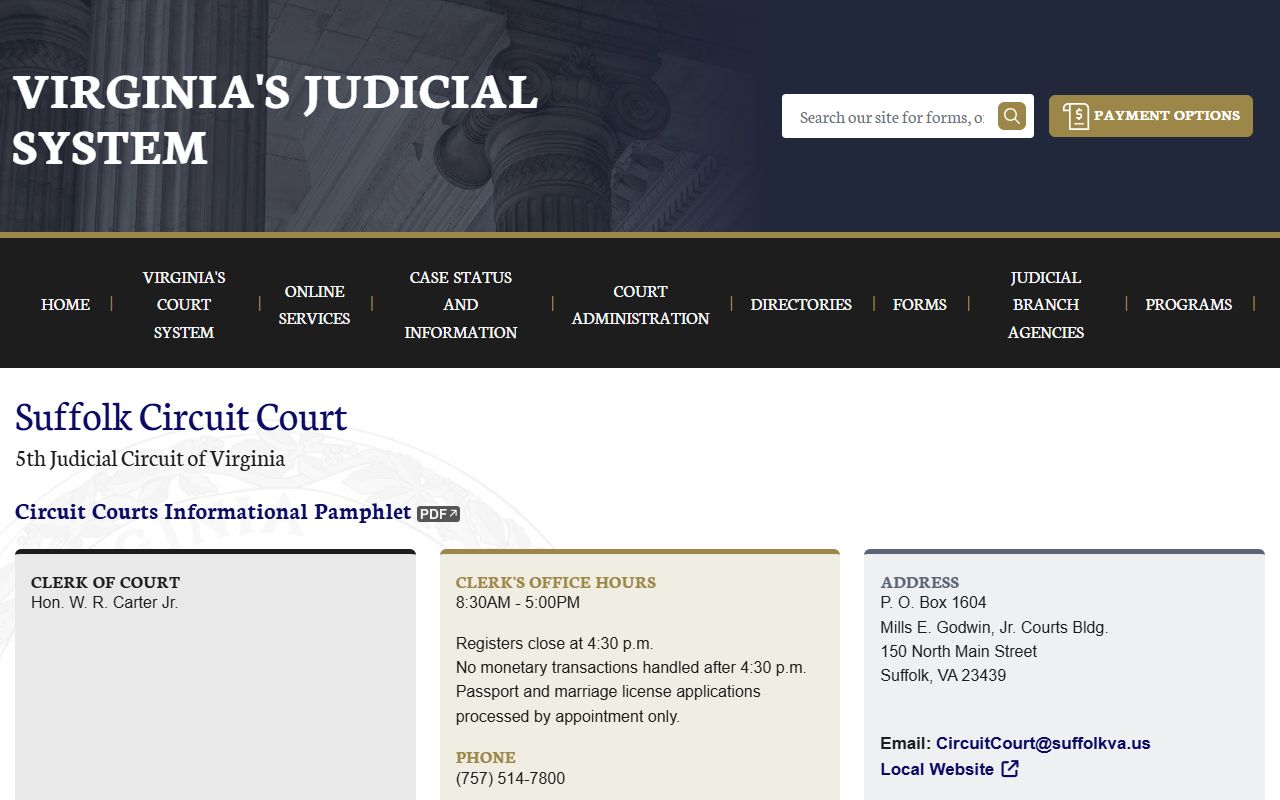
Check the court website before visiting or submitting documents to confirm current hours, fees, and any updates to recording procedures.
Nearby Cities
Suffolk is part of the Hampton Roads region and is near several other independent cities, each with its own circuit court and deed records system.