
Search Franklin County Deed Records
Franklin County deed records are kept by the Circuit Court Clerk in Rocky Mount, Virginia, the county seat for this 22nd Judicial Circuit county. The clerk's office records all real property instruments affecting land in Franklin County, maintains grantor and grantee indexes, and provides public access to deed books dating back to the county's formation. If you need a warranty deed, deed of trust, plat map, deed of release, or any other recorded land instrument, you can start your search through the SRA online index or visit the Rocky Mount courthouse in person.
Franklin County Overview
Franklin County Circuit Court Clerk
The Circuit Court Clerk for Franklin County is based at the Franklin County Courthouse in Rocky Mount. This office is the official repository for all real property recording in the county. When someone records a deed or other land instrument, the clerk receives the document, assigns it a deed book and page number, scans and indexes it, and makes it available for public inspection. Every deed, deed of trust, plat, easement, and related instrument affecting Franklin County real estate must pass through this office to be legally effective against third parties who later acquire an interest in the property.
The Franklin County Circuit Court page on the Virginia courts website lists the clerk's current address, phone number, and office hours. Hours can change, so call before driving out to record documents or pick up copies. The recording window frequently closes an hour or two before the office closes, and staff can give you the exact cutoff time when you call. They can also tell you whether there are any special instructions or forms you need for the type of instrument you want to record.
Under Virginia Code § 17.1-223, the clerk must maintain a grantor-grantee index for all recorded land instruments. The index entry for each document shows the instrument type, the recording date, and the deed book and page where the full document is filed. That book-and-page reference is what you need to find any specific deed or lien in the Franklin County records. The grantor index lets you search by the name of the person who transferred or conveyed an interest, while the grantee index lets you search by the name of the person who received it.
Searching Franklin County Deed Records Online
Virginia's Secure Remote Access (SRA) system provides free online access to the Franklin County land record index. You can search by grantor or grantee name and get back a list of recorded instruments with their type, date, and deed book and page reference. The index search costs nothing. Whether you can view full document images online depends on what the Franklin County clerk has made available through the system. Some offices offer free image access through SRA; others require a paid subscription or an in-person visit for the actual documents.
Call the Franklin County clerk's office before you start to confirm what is currently available online. That can save you a trip to Rocky Mount if you only need basic index information, or help you plan your visit if you need document images that are not online. The clerk's staff can also tell you the best way to search for older records that may not yet be in the computerized index.
In-person research is available at the courthouse during business hours. Public terminals in the clerk's office let you search the index on your own. Once you find the deed book and page reference you need, staff can help you locate the physical deed book or pull a scanned copy of the document. Bring the property owner's name or, if you have it, the Franklin County tax map parcel number. Either one helps narrow the search faster than starting with just a street address.
For deed books that predate the county's computerized records, the Library of Virginia holds microfilm copies going back to the county's formation in 1786. The LVA's online catalog shows which volumes they have and what format is available. If you are researching a long chain of title or tracing ownership back more than 50 or 60 years, the LVA is often an essential stop alongside the county clerk's office. Some early volumes have also been digitized and are searchable online through the LVA's catalog.
What Gets Recorded in Franklin County
Warranty deeds are the most common instrument recorded in Franklin County's deed books. They transfer title from a seller to a buyer with a guarantee from the seller that the title is clear and that the seller will defend it against any claims. The legal framework for general warranty deeds in Virginia is set out in Virginia Code § 55.1-300. Quit-claim deeds are also recorded, though they transfer title without any warranty or guarantee of ownership.
Deeds of trust are filed to secure mortgage loans. They give the lender a lien on the property by conveying a security interest to a trustee, who holds it on the lender's behalf until the loan is repaid. When a mortgage or deed of trust is fully paid, a deed of release or certificate of satisfaction is recorded to remove the lien. Plat maps document the layout of subdivisions, the boundaries of individual lots, and any easements shown on the subdivision plan. Easement deeds separately record rights granted to a utility, a neighbor, or another party to use a portion of the property for a specific and defined purpose.
Mechanic's liens, lis pendens notices, and powers of attorney affecting real property may also appear in Franklin County's deed books. Under Virginia Code § 55.1-407, recording is what makes a conveyance or lien effective against later purchasers and creditors. An unrecorded deed can be voided by a subsequent bona fide purchaser who records first. That rule is why the deed books are the definitive and authoritative source for property ownership history in Franklin County.
How to Record a Deed in Franklin County
To record a deed in Franklin County, bring the original signed and notarized document to the clerk's office during recording hours. Virginia's formatting requirements must be met before the clerk will accept the document. A cover sheet is required under Virginia Code § 17.1-227. The cover sheet must include the names of all grantors and grantees, the preparer's name and address, the instrument type, and the property's tax map parcel identification number, which is separately required by Virginia Code § 17.1-252. Pages must be numbered. Social Security numbers cannot appear in any recorded document.
Electronic recording (eRecording) is an option for some document types. Law firms and settlement companies use eRecording to submit instruments to the Franklin County clerk without going to the courthouse in person. The document gets a recording date the same day it is accepted, which is usually faster than mailing or hand-delivering. Ask the clerk's office whether the instrument you want to record qualifies for eRecording before you set up the submission.
After the clerk accepts the document and the fee is paid, the instrument is stamped with the recording date, deed book number, and page number. You receive a conformed copy with those details. Keep that copy with your title documents. It is your proof of recording and the reference you will need if any dispute ever arises about whether the instrument was properly filed.
Recording Fees and Taxes in Franklin County
Recording fees in Virginia are set by Virginia Code § 17.1-275 and apply statewide, including in Franklin County. The base fee is $18 for a document of ten pages or fewer. Documents from eleven to thirty pages cost $32. Documents of thirty-one or more pages cost $52. Plain copies of recorded pages cost $0.50 per page. Certified copies are $2.00 for the first page, $0.50 for each additional page, plus a per-document certification fee.
Most real estate conveyances are also subject to the Virginia grantor's tax. Under Virginia Code § 58.1-801, the tax rate is 25 cents per $100 of the value of the property conveyed, or the actual consideration paid, whichever is greater. The seller pays the grantor's tax in most transactions, though the parties can agree otherwise. Certain transfers are exempt under Virginia Code § 58.1-811. Common exemptions include transfers between spouses, gifts to family members in some cases, transfers to government entities, and certain transactions involving trusts. If your transaction might qualify for an exemption, note the applicable code section on the cover sheet and ask the clerk's office to confirm before you file.
Check what forms of payment the Franklin County clerk accepts before you arrive. Most offices take cash, check, and money order. Credit and debit card acceptance varies by county. Knowing this ahead of time avoids an awkward situation when you arrive with a recording fee due and the wrong form of payment.
Franklin County Land Records History
Franklin County was formed from Bedford and Henry counties in 1786, and its deed books date from that year. The county's land records cover more than two centuries of property ownership in southwestern Virginia's Blue Ridge foothills, including farmland, mountain tracts, timberland, and more recently developed residential and commercial properties. The older deed books, especially those from the late 18th and 19th centuries, are widely used by genealogists, historians, and title researchers tracing early land grants and family land ownership in this part of the state.
The Library of Virginia holds microfilm copies of many early Franklin County deed books and has digitized some of those volumes as well. The LVA's online catalog shows what is available and in what format. For records from the latter part of the 20th century forward, the Franklin County clerk's computerized index is accessible through the SRA system. If you are working across a broad time span on a title search or a genealogy project, you may need to use both the LVA and the county clerk's office to cover the full range of records you need.
Getting Copies of Franklin County Deed Records
Copies of deed records in Franklin County are available directly from the Circuit Court Clerk's office in Rocky Mount. In-person requests are the quickest. Bring the deed book and page number if you have it, or the grantor or grantee name and approximate year if you need to search first. Staff can locate the document in the index and make a copy while you wait in most cases. Plain copies cost $0.50 per page. Certified copies carry an additional per-document fee on top of the per-page charge.
You can also request copies by mail. Write to the clerk's office and include enough information to identify the document, along with payment by check or money order. If you need a certified copy, say so in your letter. Allow several business days for the clerk to process the request and mail the copies back to you. Calling ahead to confirm the fee before you send payment can prevent delays caused by underpayment.
Under Virginia Code § 17.1-249, land records are public records and must be available for inspection and copying during regular business hours. Anyone can request copies. You do not need to be the property owner, an attorney, or a party to the transaction. The clerk cannot restrict access based on who you are or why you need the record. Deed records in Virginia are open to the public without restriction.
The image below is from the Franklin County Circuit Court page, the official source for current clerk contact information and office hours.
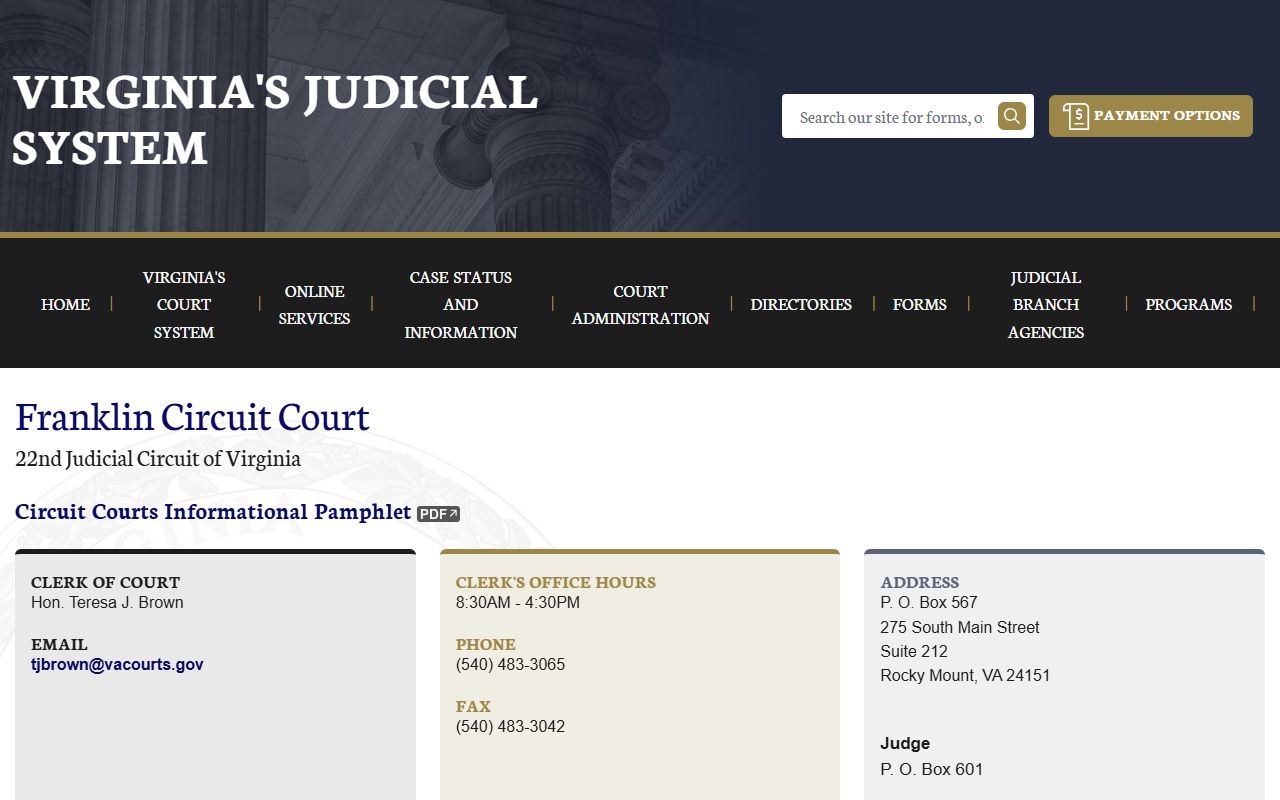
Check the court's page before visiting to confirm current hours and any changes to recording procedures.
Nearby Counties
These counties border Franklin County or are nearby in the 22nd Judicial Circuit area, each with its own Circuit Court Clerk handling local land records.