
Frederick County Deed Records Search
Frederick County deed records are maintained by the Circuit Court Clerk in Winchester, Virginia, the county seat for this 26th Judicial Circuit county. The clerk records all real property instruments affecting land in Frederick County, keeps grantor and grantee indexes going back centuries, and makes deed books available to the public. If you need to find a warranty deed, deed of trust, plat map, deed of release, or other recorded land document, the SRA online system gives you free index access, or you can visit the Winchester courthouse in person.
Frederick County Overview
Frederick County Circuit Court Clerk
The Circuit Court Clerk for Frederick County operates from the courthouse in Winchester. The clerk's office is the official repository for all land records in Frederick County. It accepts new instruments for recording, assigns each one a deed book and page number, scans and indexes the document, and makes it available for public inspection. Every deed, deed of trust, plat, easement, release, and related property instrument for land in Frederick County must be recorded here to be legally effective against future purchasers or lienholders.
The Frederick County Circuit Court page on the Virginia courts website lists the clerk's current address, phone number, and hours. Call before you go to record documents or pick up copies, since office hours and recording cutoff times can change. The staff can also tell you if there are any specific instructions for the type of document you want to file. Frederick County is one of Virginia's older counties with a very deep deed book archive, and the staff are used to helping researchers navigate both old and new records.
The clerk indexes all instruments under both grantor and grantee names as required by Virginia Code § 17.1-223. Each index entry includes the instrument type, recording date, and deed book and page number. The grantor index lets you search by the name of the person who transferred or conveyed a property interest. The grantee index lets you search by the name of the person who received it. Both are essential for a complete title search going back through multiple ownership changes.
Searching Frederick County Deed Records Online
Virginia's Secure Remote Access (SRA) system is the primary online tool for searching Frederick County land records. The index search is free. You can look up records by grantor name, grantee name, or both, and get results showing the instrument type, recording date, and deed book and page number. That information is usually enough to confirm whether a deed or lien is on file and when it was recorded. Whether full document images are accessible online depends on what the Frederick County clerk has made available through the system.
Contact the Frederick County clerk's office to find out what you can access online versus what requires an in-person visit. Some document types or older records may not be available through SRA and may require you to go to the Winchester courthouse or request copies by mail. The clerk's staff are generally helpful in directing you to the right resource for what you need.
For those who prefer in-person research, public terminals at the courthouse allow you to search the index and, in many cases, view document images on your own. Bring the property owner's name or the Frederick County tax parcel number if you have it. Staff can assist with older or harder-to-find records.
For deed books that predate the county's computerized records, the Library of Virginia holds microfilm copies going back to the county's earliest years. Frederick County was established in 1743, and its deed records are among the oldest in the Shenandoah Valley. The LVA's online catalog shows which volumes are available, and some early Frederick County deed books have been digitized. If you are working on a pre-Civil War title chain or a genealogy project involving 18th- or 19th-century land ownership, the LVA is an essential stop.
What Gets Recorded in Frederick County
Warranty deeds are the most common instrument filed in Frederick County deed books. They transfer ownership from seller to buyer with a warranty that the seller holds clear title. The legal basis for general warranty deeds in Virginia is Virginia Code § 55.1-300. Quit-claim deeds, which transfer whatever interest the grantor holds without any warranty, also appear in the books frequently, particularly in family transfers and divorce settlements.
Deeds of trust are recorded to secure mortgage loans and other debts. The lender's lien is established by the deed of trust, and when the loan is paid off, a deed of release or certificate of satisfaction is recorded to clear the lien. Plat maps record subdivision layouts and lot boundaries. Easement deeds establish rights for utilities, neighbors, or other parties to use portions of a property for defined purposes such as power lines, water lines, or access roads. Boundary line agreements, deeds of correction, and affidavits affecting title are also recorded here.
Under Virginia Code § 55.1-407, an unrecorded deed or instrument is void against a later purchaser or creditor who pays value in good faith and records first. That recording priority rule is what makes the Frederick County deed books the definitive source for determining who owns what and what liens are outstanding on any given parcel of land. A thorough title search requires checking both the grantor and grantee indexes to get the full picture.
How to Record a Deed in Frederick County
To record a deed or other land instrument in Frederick County, bring the original signed and notarized document to the Circuit Court Clerk's office in Winchester during recording hours. The document must meet all of Virginia's formatting requirements. A cover sheet is required under Virginia Code § 17.1-227 and must list the names of all grantors and grantees, the preparer's name and address, the instrument type, and the property's tax map parcel identification number. The parcel ID requirement is separately stated in Virginia Code § 17.1-252. Pages must be numbered, and no Social Security numbers may appear anywhere in the document.
Electronic recording (eRecording) is available for qualifying document types. Settlement companies and law firms use eRecording to submit instruments directly to the clerk without visiting in person. The document typically receives a recording date the same day it is accepted electronically. If you are involved in a real estate closing or a commercial transaction, ask your settlement agent or attorney whether eRecording is available for your documents. It is generally faster and more convenient than a physical submission.
Once the clerk accepts and records the document, it is stamped with the recording date, deed book number, and page number. You get a conformed copy showing those details. Keep this copy with your other title documents. The deed book and page reference on the conformed copy is how you or anyone else will find the recorded instrument in the future. The original stays with the clerk as part of the permanent land record for Frederick County.
Recording Fees and Taxes in Frederick County
Virginia sets recording fees by statute, and the same fee schedule applies throughout the state. Under Virginia Code § 17.1-275, the base recording fee is $18 for a document of ten pages or fewer, $32 for documents from eleven to thirty pages, and $52 for documents of thirty-one pages or more. Plain copies of recorded pages cost $0.50 per page. Certified copies are $2.00 for the first page and $0.50 per additional page, plus a per-document certification fee.
Real estate conveyances are also subject to the Virginia grantor's tax under Virginia Code § 58.1-801. The tax rate is 25 cents per $100 of the property's value or the consideration paid for the transfer. The grantor's tax is the seller's obligation in a typical transaction, though the contract between the parties may allocate it differently. Certain transfers qualify for an exemption under Virginia Code § 58.1-811, including transfers between spouses, gifts to qualified relatives, transfers to governmental entities, and certain corporate or trust transactions. If you believe your transfer qualifies for an exemption, cite the applicable code section on the cover sheet. The clerk can confirm which box to check but cannot give legal advice on whether the exemption applies to your situation.
Confirm payment methods with the Frederick County clerk before you arrive. Cash, check, and money order are standard. Credit and debit card availability varies across Virginia's clerk offices, so it is worth checking ahead if you plan to pay by card.
Frederick County Land Records History
Frederick County is one of Virginia's oldest counties, formed in 1743 from Orange County. Its deed books date back more than 280 years, making the Frederick County land record archive among the most historically significant in the Shenandoah Valley. The early deed books document land grants from the colonial period, including original patents issued by the Crown and later grants from the Commonwealth of Virginia. These records are invaluable for tracing land ownership chains that go back to the very start of organized European settlement in the region.
The Library of Virginia holds microfilm copies of early Frederick County deed books and has digitized some of the oldest volumes. The LVA's catalog shows which volumes are available and how to access them. For records from more recent decades, the Frederick County clerk's office maintains a computerized index accessible through the SRA system. Researchers working across the full time span of the county's history will typically use both resources, moving from the LVA for older records to the SRA index and the clerk's office for more recent ones.
Title searches for Frederick County real estate covering the standard 60-year period are usually done through the clerk's office and the SRA system. For older rural properties or those involved in estate administration with long family histories, the search may need to go further back. The depth of Frederick County's land record archive means that a complete chain of title is almost always traceable if you know where to look.
Getting Copies of Frederick County Deed Records
Copies of deed records in Frederick County are available from the Circuit Court Clerk's office in Winchester. You can request them in person, by mail, or in some cases electronically. In-person requests are fastest. Bring the deed book and page number or the names of the parties and approximate recording year. Staff can locate the document and make a copy while you wait. Plain copies cost $0.50 per page. Certified copies carry an additional per-page fee and a per-document certification charge.
Mail requests work well if you already know the deed book and page number. Write to the clerk's office with the document identifier and enclose payment by check or money order. The clerk will mail copies to you after processing. If you are not sure of the exact fee, call first to get an estimate. Allow several business days for the request to be fulfilled. For bulk research projects involving many documents, arranging an in-person visit is usually more efficient than sending multiple mail requests.
Under Virginia Code § 17.1-249, land records are public records and must be open for inspection and copying during regular business hours. There is no requirement to prove ownership or state a reason for the request. Any member of the public can ask for a copy of any recorded deed in Frederick County. The clerk has no authority to deny access or demand that you justify why you need the document.
The image below is from the Frederick County Circuit Court page, the official source for current clerk contact information and office hours.
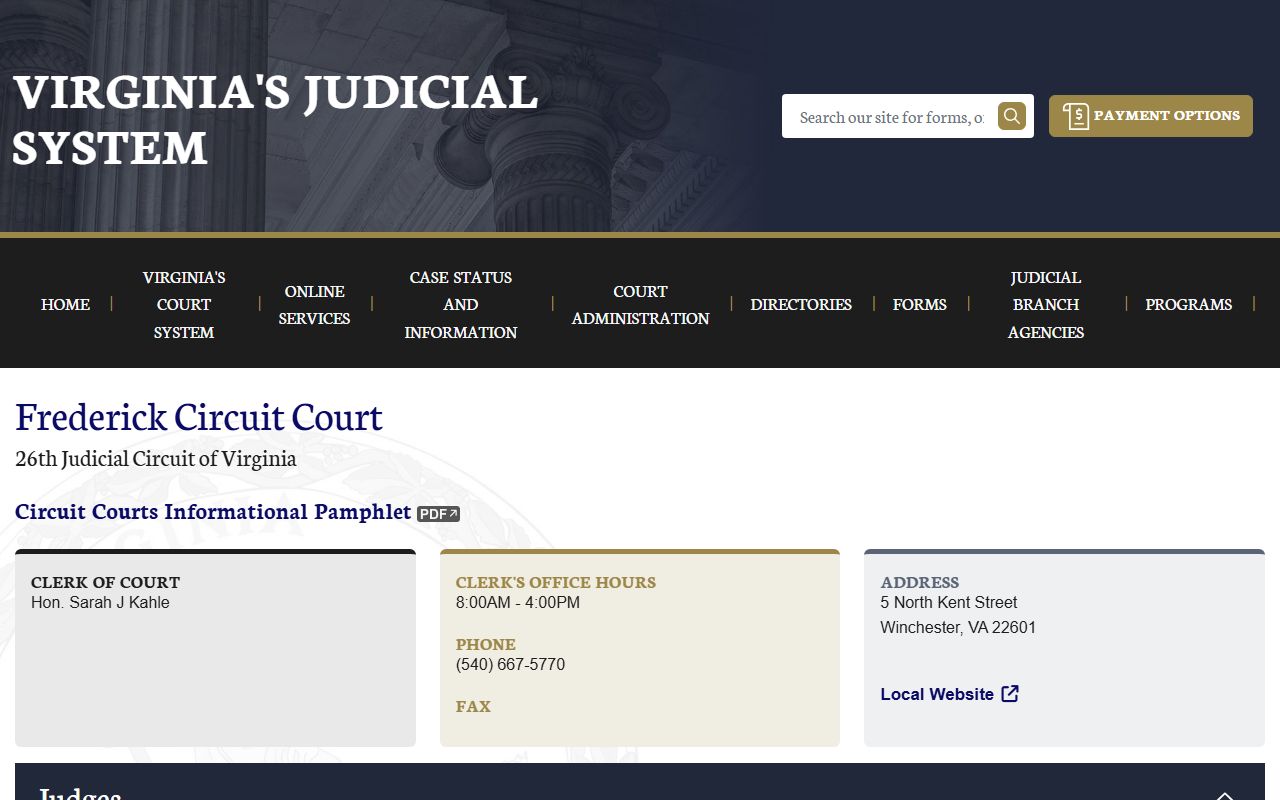
Check the court's page before visiting to confirm current hours and any changes to recording procedures.
Nearby Counties
These counties border Frederick County or are close by in the northern Shenandoah Valley area, each with its own Circuit Court Clerk handling local land records.