
Access Roanoke County Deed Records
Roanoke County deed records are maintained by the Circuit Court Clerk and cover all land records, grantor and grantee indexes, and recorded real property instruments for property within county limits. Roanoke County is a separate legal jurisdiction from both the City of Roanoke and the City of Salem, and each of the three has its own Circuit Court. To search deed records, get a certified copy of a deed, or record a new property instrument for land in Roanoke County, the Roanoke County Circuit Court Clerk's office in Salem is where to go.
Roanoke County Overview
Roanoke County Is Not the City of Roanoke
Virginia has a system of independent cities that are legally separate from any surrounding county. The Roanoke area is one of the clearest examples of how this creates confusion about where to file or find deed records. Roanoke County, the City of Roanoke, and the City of Salem are three entirely distinct jurisdictions. Each has its own government, its own circuit court, and its own deed record repository. They do not share records.
Property in the City of Roanoke gets recorded at the Roanoke City Circuit Court. Property in the City of Salem gets recorded at the Salem Circuit Court. Property in unincorporated Roanoke County gets recorded at the Roanoke County Circuit Court. The Roanoke County Circuit Court happens to be physically located in Salem, even though Salem is a separate independent city. The court serves the county, not the city. Deeds for Salem properties still go to the Salem Circuit Court.
If you are not sure which jurisdiction covers a parcel, check the tax map parcel ID, the Virginia Department of Taxation property records, or call the Roanoke County Circuit Court directly. Staff can usually determine by parcel number which office holds the records. Getting this right before you visit saves a trip.
Roanoke County is an active recording jurisdiction. The county surrounds the City of Roanoke on several sides and has steady residential and commercial real estate activity. The clerk's office processes a significant volume of deed recordings each year, covering everything from small residential lots to large tracts on the county's rural edges.
Roanoke County Circuit Court Clerk
The Roanoke County Circuit Court Clerk is the official custodian of land records for all property in unincorporated Roanoke County. The office records new deeds and other instruments, assigns them to deed books, maintains the grantor and grantee indexes, and provides public access during regular business hours. Each document submitted for recording is reviewed for compliance with state requirements before it is accepted. Under Virginia Code § 17.1-223, the clerk has a statutory duty to maintain a general index of all recorded land instruments organized by party name.
The Roanoke County Circuit Court is part of Virginia's 23rd Judicial Circuit. The clerk's office is located in Salem, Virginia. For current office hours, mailing address, phone number, and contact details, check the court's website. If you are mailing a recording submission, include a self-addressed stamped envelope so the clerk can return your original documents after they are entered into the record.
The grantor/grantee index maintained under Virginia Code § 17.1-249 is the core search tool for Roanoke County deed records. The grantor side tracks instruments by the name of the party conveying or encumbering property. The grantee side tracks the party receiving an interest. Using both sides together lets you trace ownership forward and backward through time and build a complete chain of title for any parcel in the county.
Searching Roanoke County Deed Records Online
Virginia's free Secure Remote Access (SRA) system provides online access to the deed index for Roanoke County. Search by grantor or grantee name to retrieve the instrument type, recording date, and deed book and page reference. The SRA is maintained by the Supreme Court of Virginia and updated regularly. No account is required for a basic name search. This is the fastest way to find a deed reference without traveling to Salem.
Full document images through the SRA may require a paid subscription. If you need copies of the recorded pages themselves, ask the clerk about subscription access or submit a copy request directly. For researchers who do regular deed work in the county, a subscription can save time and money compared to ordering individual copies. For a one-time search, the free index is usually enough to identify what you need before requesting a copy.
In-person access is available at the clerk's office during regular business hours. Public terminals let you run the same searches as the SRA. Once you have a deed book and page, staff can locate the physical record and make a copy. Bring the property owner's name or the Roanoke County tax map parcel ID. For older records before the computerized index, the clerk maintains bound deed books and manual index volumes that can be reviewed in person.
Older Roanoke County land records are also available through the Library of Virginia. The LVA holds microfilmed deed books covering earlier periods in the county's history. Their catalog shows what is available on microfilm and whether any collections are digitized. For title research that needs to extend back several decades or more, the LVA is a useful supplement to the SRA index for more recent records.
What Gets Recorded in Roanoke County
Any instrument that affects title to real property in Roanoke County must be filed with the Circuit Court Clerk. Warranty deeds are the most common type and transfer property with a guarantee of good title. Virginia Code § 55.1-300 sets the format requirements for Virginia deeds, including that grantor and grantee surnames appear in all caps or underscored in the first clause and that all pages are numbered. Quitclaim deeds transfer the grantor's interest without a title guarantee and are common in estate and family transfers.
Deeds of trust are recorded when real property is used as collateral for a loan. When the loan is paid off, a certificate of satisfaction releases the trust deed. Both the deed of trust and the certificate of satisfaction need to appear in the deed books to reflect the current state of title. Easement grants for roads, utilities, drainage, and similar uses are also part of the deed book record. Subdivision plats must be recorded when land is divided into lots, and they need to be filed before any of those lots can be conveyed.
Judgment liens, lis pendens notices, powers of attorney for real estate, UCC filings affecting fixtures or real property collateral, and condominium declarations are among the other types of instruments filed at the circuit court level. A thorough title search in Roanoke County looks at all of these, not just deeds. Any of them can affect the marketability of title or reveal encumbrances the buyer needs to know about.
Under Virginia Code § 55.1-407, an unrecorded deed is void against a bona fide purchaser who records first. Virginia's race-notice recording system rewards prompt filing. Prompt recording after any property transfer in Roanoke County is essential to protect your ownership interest against competing claims.
How to Record a Deed in Roanoke County
To record a deed or other land instrument in Roanoke County, bring the original signed and notarized document to the clerk's office in Salem. The document must be an original with a wet ink signature and a proper notarial acknowledgment. Photocopies are not accepted. Number all pages before submitting. The clerk reviews the document, confirms it meets state requirements, calculates fees and taxes, and accepts payment before entering the deed into the record.
A cover sheet is required under Virginia Code § 17.1-227. The cover sheet provides the party names, instrument type, and indexing details the clerk needs. That same statute prohibits Social Security numbers in any recorded document. Remove SSNs from any draft before submitting. Documents containing SSNs are rejected.
The tax map parcel identification number must appear on the first page of the deed under Virginia Code § 17.1-252. Get that number from the Roanoke County commissioner of revenue before drafting the deed. Missing parcel IDs are among the most common reasons documents are turned away at Virginia clerk counters. If you mail a recording, include a self-addressed stamped envelope for the return of your originals after recording.
Contact the clerk's office about eRecording availability if you handle multiple transactions. Title companies and settlement agents sometimes use eRecording when the county accepts it from approved providers. Whether Roanoke County accepts electronic submissions can change, so verify directly with the office before relying on it for a specific transaction.
Recording Fees and Taxes in Roanoke County
Roanoke County recording fees follow the statewide schedule under Virginia Code § 17.1-275. The fee is $18 for documents of 10 pages or fewer, $32 for 11 to 30 pages, and $52 for 31 or more pages. Count all pages including the cover sheet and exhibits to determine the right fee. These fees are uniform across Virginia circuit courts. A share of each fee supports the Library of Virginia's records preservation work.
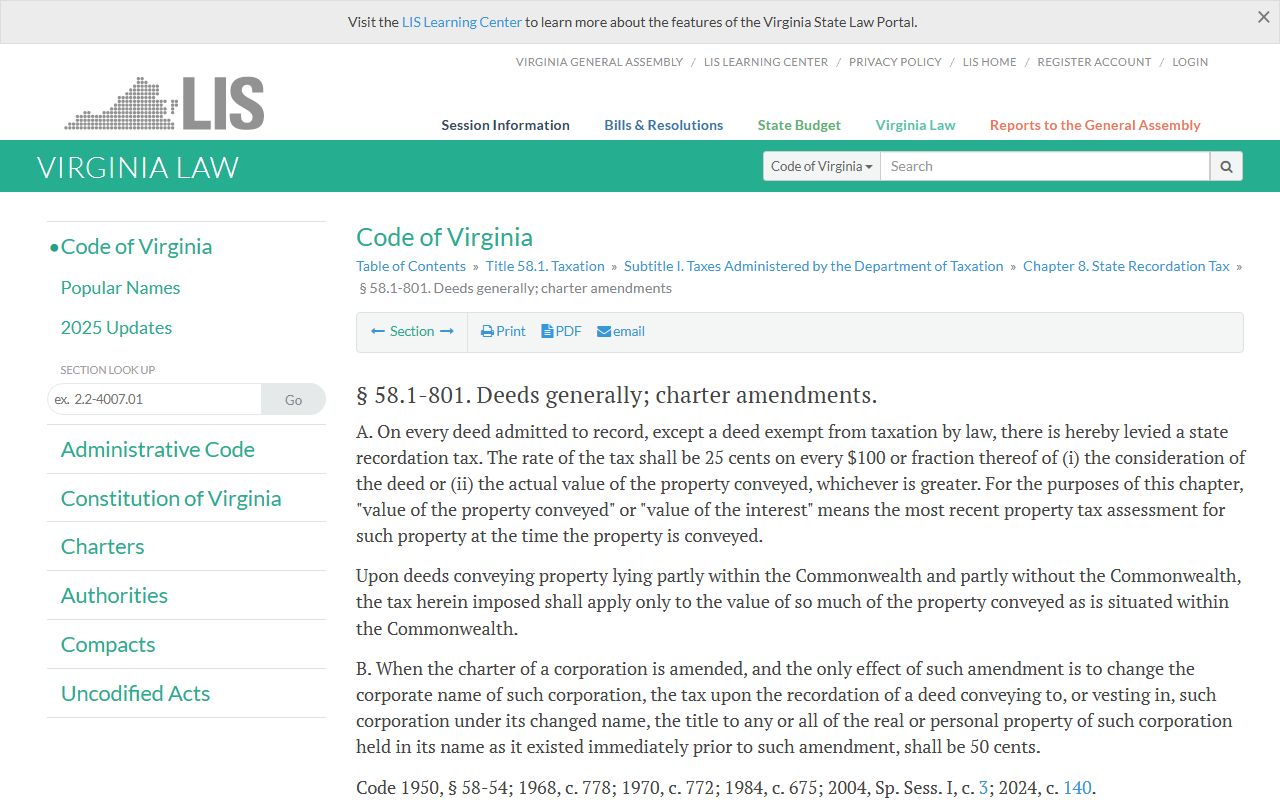
Most deed transfers are subject to the state recordation tax under Virginia Code § 58.1-801 at 25 cents per $100 of stated consideration or actual value. The tax is collected at the time of recording along with the recording fee. For a $350,000 residential sale in Roanoke County, the recordation tax alone is $875. Both the fee and the tax must be paid before the clerk accepts the document.
Certain transfers qualify for a recordation tax exemption under Virginia Code § 58.1-811. Transfers between spouses, corrective deeds with no change in ownership, and certain gifts to family members are among the categories that may be exempt. Note the applicable exemption on the deed or cover sheet and explain it to the clerk. The clerk determines whether the exemption applies before accepting the recording. If you are unsure, ask before you submit.
Copies of recorded deeds cost $0.50 per page. Certified copies carry an additional fee on top of the per-page charge. Call ahead if you need certified copies for legal or official use. Plain research copies are usually available the same day if you visit in person.
Roanoke County Land Records History
Roanoke County was established in 1838 from Botetourt County, giving it roughly two centuries of deed book history. The clerk's office holds deed books going back to the county's formation, and older volumes are part of the permanent public record available for in-person review. For deed books from the 19th and early 20th centuries, microfilm copies at the Library of Virginia are often the most practical way to access older records without handling fragile originals.
The LVA catalog lists which Roanoke County deed books have been microfilmed and whether any have been digitized for remote access. For extended title research or genealogical work going back many decades, the LVA is the most complete resource for pre-computerization era Roanoke County land records. Their reading room in Richmond is open to the public, and staff can help you identify the right materials for a given county and time period.
For periods before the SRA index was established, handwritten and typed index books are maintained at the courthouse. These older indexes are organized alphabetically by surname. Staff at the Roanoke County courthouse can help orient researchers to the older volumes and explain how the pre-computerization indexes are structured. Knowing approximately when a transaction occurred helps focus the search in the older manual index books.
Getting Copies of Roanoke County Deed Records
Copies of Roanoke County deed records are available in person at the clerk's office in Salem, by mail, or through the SRA system for subscribers. In-person requests are fastest. Bring the deed book and page number, or the party names and approximate recording date. Staff can locate the document and make a copy on the spot. Plain copies cost $0.50 per page. Certified copies are available for an additional fee and are needed when the copy will be used in court proceedings or official filings.
Mail requests work for most research needs. Include the deed book and page number, party names, recording year, and parcel ID if you have it. State whether you need a plain or certified copy. Include a check for the estimated fee and a self-addressed stamped envelope. Call the clerk first if you are unsure of the exact cost to avoid delays from short payment. The clerk can also confirm whether the document has been fully indexed and is ready for a copy request.
Roanoke County has a moderate volume of deed activity, and the clerk's office processes copy requests along with new recordings. Turnaround for mail requests is typically one to two weeks for routine matters. If you have a time-sensitive need, calling ahead and explaining the situation often helps. Title companies and attorneys doing closing work sometimes have established relationships with the clerk's office that make urgent requests easier to handle.
The image below is from the Virginia SRA system, the statewide online portal for searching circuit court deed indexes, including Roanoke County. Use the SRA to search by party name before visiting the clerk's office in Salem or submitting a mail request.
The SRA index is the most efficient starting point for any online Roanoke County deed search. It is free to use and covers all recorded instruments in the county's computerized index.
Nearby Counties
Adjacent counties each maintain their own deed records at their own Circuit Court Clerk offices. Note that the City of Roanoke and City of Salem are independent jurisdictions with their own circuit courts, separate from Roanoke County.