
Fairfax City Deed Records
Fairfax deed records are not filed with the City of Fairfax Circuit Court. Instead, all property deeds, deeds of trust, and land instruments for real estate located within the City of Fairfax must be recorded with the Fairfax County Circuit Court Clerk. This is one of Virginia's unusual recording arrangements. The city has its own court for litigation, but land records have always been maintained at the county level. If you are searching for a deed covering a City of Fairfax property, you need to look in the Fairfax County land records index, not the city court system.
Fairfax Overview
Where to Record Fairfax City Deeds
The City of Fairfax is an independent city, but it is one of a handful of Virginia cities that record land instruments through the surrounding county rather than through the city's own circuit court. Deeds, deeds of trust, easements, and all other instruments affecting real property within the City of Fairfax are recorded with the Fairfax County Circuit Court Clerk.
The Fairfax County Circuit Court Clerk's office is located at 4110 Chain Bridge Road, Fairfax, VA 22030. The recording window is open Monday through Friday. You can reach the clerk's office by calling 703-691-7320. Mail submissions and eRecording through approved vendors are accepted. Do not submit a City of Fairfax deed to the City of Fairfax Circuit Court at 4000 Chain Bridge Road, as that office does not maintain land records.
This setup can be confusing because both courthouses sit within a few blocks of each other on Chain Bridge Road. The city court handles civil and criminal cases for city residents. The county clerk's office handles all deed recording, deed books, and land record indexes for property in the city. Always confirm you are at the right building before submitting documents.
Searching Fairfax City Deed Records Online
Because City of Fairfax land records are maintained by Fairfax County, you search them through the Fairfax County index. Virginia's free SRA system provides a grantor and grantee index for Fairfax County that covers City of Fairfax properties. Enter the property owner's name or search by date range. The results show instrument type, recording date, deed book, and page number.
Fairfax County also maintains its own online land records portal with more detailed search options. You can search by subdivision name, tax map reference number, or instrument type in addition to the standard name-based search. This is useful when you know the parcel but not the current owner's name.
The Library of Virginia holds older Fairfax County deed books on microfilm and in digitized form. For deeds recorded before modern electronic indexing, the LVA is often the fastest way to locate an instrument. The LVA's online catalog lets you identify the correct reel or volume before making a trip to Richmond.
In-person research at the Fairfax County Clerk's office is available during business hours. Public access terminals let you search the index and view document images. Staff can assist with older records and certified copy requests.
Types of Instruments Recorded in Fairfax
The Fairfax County clerk records a broad range of instruments for City of Fairfax properties. Common document types include warranty deeds, special warranty deeds, quitclaim deeds, deeds of gift, deeds of trust and deeds of release, certificates of satisfaction, easement agreements, subdivision plats, condominium declarations, powers of attorney related to real estate, and judgment liens.
Virginia follows a race-notice recording system under Virginia Code § 55.1-407. This means a later purchaser who records first and had no notice of a prior unrecorded deed can take priority over that earlier deed. In a competitive market like the City of Fairfax, prompt recording protects your ownership claim. Delays create risk. Most title companies record on the day of closing for this reason.
Plats showing lot boundaries, easements, and subdivision layouts are also part of the land record system. If you need a legal description or want to verify a boundary line for a City of Fairfax parcel, the recorded plat is the most authoritative source.
How to Record a Deed in the City of Fairfax
To record a deed covering City of Fairfax property, submit it to the Fairfax County Circuit Court Clerk. The deed must comply with the general form requirements under Virginia Code § 55.1-300. It must be signed and acknowledged before a notary public, identify the grantor and grantee by name, describe the property by metes and bounds or plat reference, and state the consideration paid or the nature of the transfer.
Under Virginia Code § 17.1-252, the first page of each deed must include the tax map reference number for the parcel. This ties the instrument to the assessor's records and is required before the clerk will accept the document. Have this number ready when you prepare the deed.
A cover sheet is required for all recorded instruments under Virginia Code § 17.1-227. The cover sheet also serves as the mechanism for redacting Social Security numbers from the public record. If a document contains an SSN, the cover sheet process allows the submitter to flag it for redaction. The clerk will not reject a document solely because it contains an SSN, but the cover sheet requirement must still be met.
Recording Fees and Taxes
Virginia recording fees are set by Virginia Code § 17.1-275. The base fee is $18 for instruments up to 10 pages. Documents of 11 to 30 pages cost $32. Instruments longer than 30 pages carry a $52 fee. These rates apply to all Fairfax County recordings, including those for City of Fairfax property.
Most deed conveyances also require payment of the state recordation tax. Under Virginia Code § 58.1-801, the grantor's tax is 25 cents per $100 of consideration. Fairfax County imposes an additional local grantor's tax on top of the state rate. Given the high property values in the City of Fairfax, these taxes can be substantial. Budget for them before closing.
Some transfers are exempt from recordation taxes under Virginia Code § 58.1-811. Transfers between spouses, certain transfers to or from business entities, and gifts to government bodies may qualify. You must note the exemption on the face of the instrument or on the cover sheet for the clerk to process it without collecting the tax.
City of Fairfax Land Records History
Fairfax was incorporated as a town in 1874 and became an independent city in 1961. Before incorporation, the land records for the area were all part of Fairfax County's deed books. When the city separated from the county, land records continued to be maintained at the county clerk's office rather than being split into a new city record system. That arrangement has remained in place ever since.
Because of this history, a single search of the Fairfax County deed books covers land going back centuries, including periods before the city existed as a separate jurisdiction. Researchers tracing chain of title for a City of Fairfax parcel often find the earliest deeds recorded under the county's books dating to the colonial period. The county's records and the city's land record history are essentially the same.
For very old records, the Library of Virginia holds deed books from Fairfax County dating to the 1700s. These are available both on microfilm and through the LVA's online catalog. If you need to trace title back before the 1960s or earlier, both the county clerk's office and the LVA are essential resources.
Getting Copies of Fairfax City Deed Records
Copies of deed records for City of Fairfax properties are available from the Fairfax County Circuit Court Clerk. Standard copies are $0.50 per page. Certified copies carry an additional certification fee.
You can request copies in person at 4110 Chain Bridge Road during regular business hours. Mail requests are accepted as well. Include the instrument number or deed book and page number, the names of the parties, and the approximate recording date to help staff locate the document quickly. Include a self-addressed stamped envelope and a check made out to the Clerk of the Circuit Court.
Fairfax County's online portal may allow you to view and print document images directly, depending on the age and type of record. Newer instruments are often fully available online without a trip to the courthouse. For older or less common records, an in-person visit or mail request may still be needed.
The screenshot below is from the City of Fairfax Circuit Court website, which provides information about the city court's jurisdiction and how it differs from the county recording office.
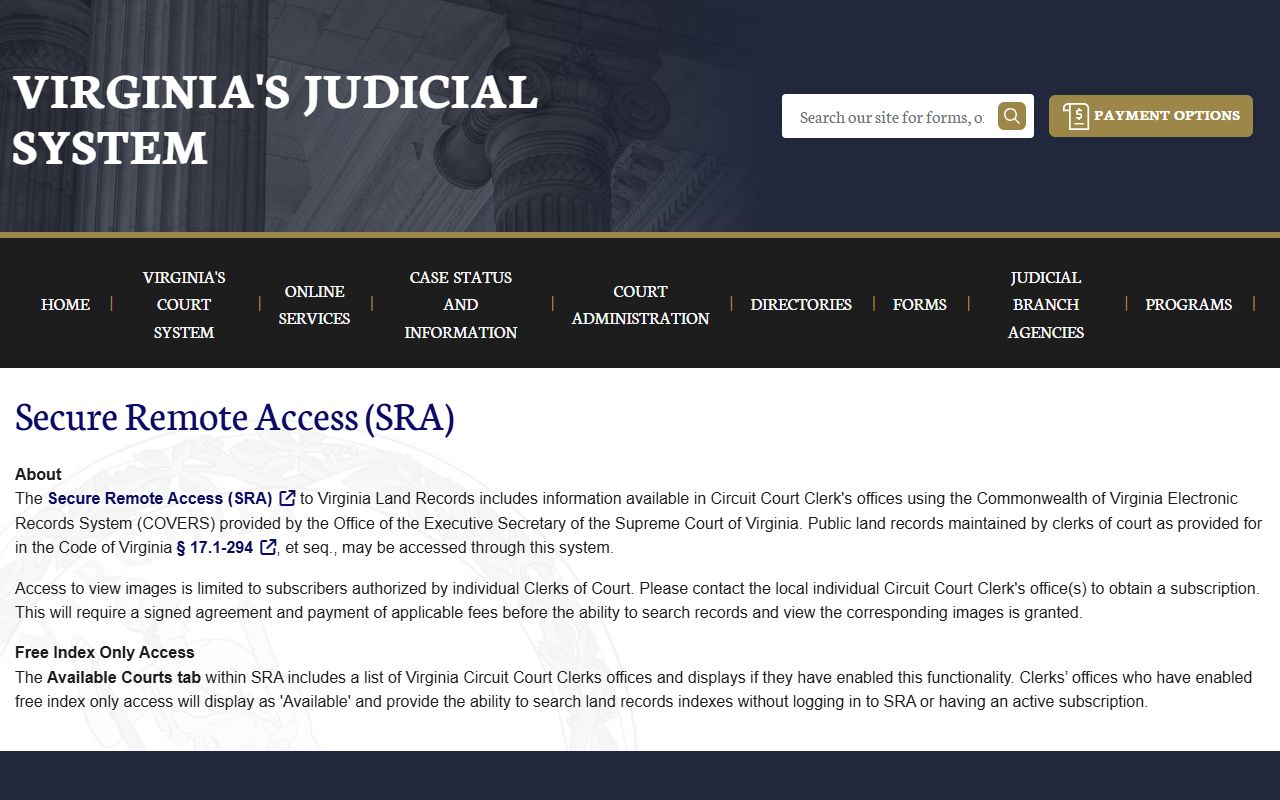
Use the county clerk's office, not the city court, for all deed recording and land record searches in the City of Fairfax.
Nearby Cities
Several independent cities and towns in Northern Virginia are also close to the City of Fairfax, each with its own recording rules.