
Charlotte County Deed Records Lookup
Charlotte County deed records are held by the Circuit Court Clerk in Charlotte Court House, Virginia, and document all real property transactions in the county. The office maintains property deeds, deeds of trust and mortgages, plat records for subdivisions, and easement documents. Anyone who needs to search land ownership, confirm title, or record a new deed can access these instruments through the clerk's office in Charlotte Court House or through Virginia's online index tools.
Charlotte County Overview
Charlotte County Circuit Court Clerk
The Circuit Court Clerk in Charlotte County is the official custodian of all land records for the county. The office records, indexes, and stores every deed, deed of trust, mortgage, plat, and related instrument filed for real property in the county. When you submit a deed, staff check it against Virginia's formatting and content requirements, collect the applicable fees and taxes, record the instrument, and return the original with a deed book and page stamp.
The Charlotte County Circuit Court is in Charlotte Court House, which serves as both the county seat and the name of the community where the courthouse stands. The court is part of Virginia's 10th Judicial Circuit. Contact the clerk's office for current hours, address, and any local filing procedures. If you plan to mail documents for recording, include a self-addressed stamped envelope for the return of your originals.
Searching Deed Records Online
Virginia's SRA (Secure Remote Access) system provides free online access to the grantor and grantee indexes for Charlotte County. You can search by party name to find instrument type, recording date, and deed book reference. Image access to the full text of recorded deeds requires a paid subscription arranged through the Circuit Court Clerk's office in Charlotte Court House.
For older records, the clerk's office maintains physical deed books that go back to the county's formation. An in-person visit to the courthouse in Charlotte Court House gives you access to these older records and to any plat books that may not be digitized. Staff at the clerk's office can help locate records by grantor or grantee name, deed book and page number, or general time period. They cannot offer legal advice, but they are generally helpful in pointing you to the right reference.
The Library of Virginia holds microfilmed land records for many Virginia counties, including older Charlotte County deed books. If you are tracing a title chain that runs back before the county's modern record-keeping systems, the LVA is worth contacting before making a trip to the courthouse.
Types of Recorded Instruments
Charlotte County's land records include warranty deeds under Virginia Code § 55.1-300, which transfer title with full guarantees of ownership. Quitclaim deeds are also recorded, conveying only the interest the grantor holds without any warranty. Deeds of trust are among the most common instruments filed, as they secure mortgage loans on Charlotte County real estate. When a loan is repaid, the lender must file a certificate of satisfaction to clear the lien from title under § 55.1-600.
Plat records document subdivision layouts and property surveys. Easement deeds grant rights across or through a property for utilities, access, or other purposes. Judgment liens, notices of lis pendens, mechanic's liens, powers of attorney used in real estate closings, and UCC filings affecting fixtures are also part of the recorded land record set. Under § 55.1-407, recording promptly protects a buyer's priority against later competing claims.
Recording Requirements and Fees
To record a deed in Charlotte County, you must submit the original document with original signatures and notarization. A cover sheet is required under § 17.1-227. The tax map parcel number must appear on the first page per § 17.1-252. Pages must be numbered. Social Security numbers are not allowed in any recorded document. The document must meet the margin and format requirements in § 55.1-300.
Recording fees set by § 17.1-275 are $18 for 10 pages or fewer, $32 for 11 to 30 pages, and $52 for more than 30 pages. The state recordation tax is 25 cents per $100 of consideration under § 58.1-801. Grantor tax under § 58.1-811 applies to most conveyances. Certified copies are $0.50 per page. Bring a self-addressed stamped envelope if you want originals returned by mail.
Mortgage and Deed of Trust Records
Mortgage and deed of trust records make up a large part of Charlotte County's land record system. When a lender finances the purchase of property in the county, a deed of trust is recorded at the clerk's office. This gives the lender a security interest in the property that appears as a lien on title. The lien stays on title until the loan is paid off and a certificate of satisfaction is recorded.
Anyone searching title in Charlotte County must check for open deeds of trust before a property changes hands. An open deed of trust with no corresponding certificate of satisfaction signals an unpaid mortgage. The SRA index allows you to search for both the original deed of trust and any subsequent satisfaction. If a satisfaction is missing, a title attorney can advise on how to address the issue before closing.
The VJEFS judgment lien system is a companion tool for identifying judgment liens that may have attached to Charlotte County property. Both tools together give you a clearer picture of the full encumbrance status of any parcel.
Easement Records in Charlotte County
Easement deeds are recorded at the Charlotte County Circuit Court Clerk's office and form part of the permanent land record. An easement gives one party the right to use another's property for a specific purpose, such as a utility line, a road, or a drainage corridor. Easements run with the land and remain in effect when the property is sold, unless formally released. They appear in the grantor/grantee index and in deed books at the clerk's office.
If you are buying land in Charlotte County that may have utility lines, shared driveways, or conservation restrictions crossing the property, an easement search as part of your title examination is important. Your title attorney or the SRA index can help identify recorded easements before closing.
The image below shows the Charlotte County Circuit Court website, where you can find current clerk contact details and local recording procedures.
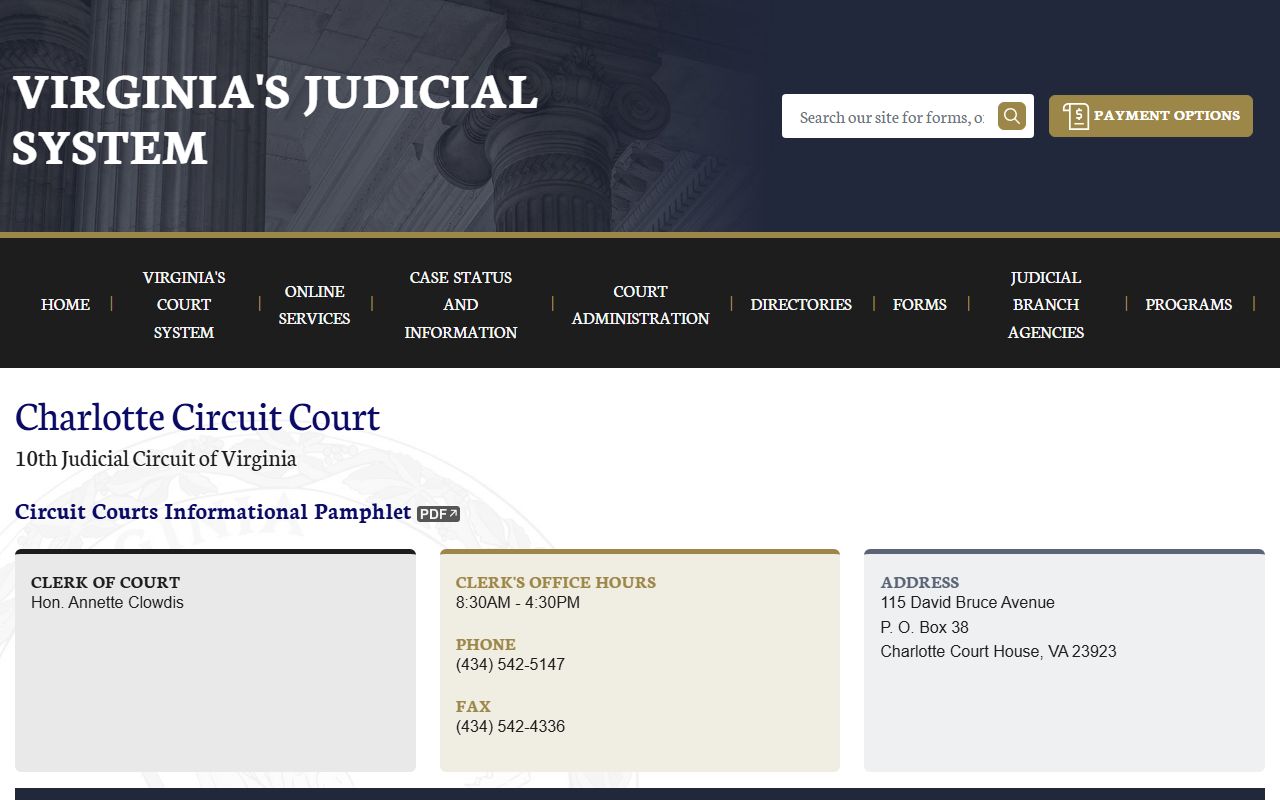
Check the court's website before visiting to confirm hours and any specific local requirements for recording deeds in Charlotte County.
Nearby Counties
Properties near Charlotte County's borders may file deed records in an adjacent jurisdiction. Confirm the correct county before recording any instrument.