
Halifax County Deed Records
Halifax County deed records are kept by the Circuit Court Clerk in Halifax, Virginia, the county seat for this 10th Judicial Circuit county in Southside Virginia. The clerk records warranty deeds, deeds of trust, quitclaim deeds, easements, plat records, and other real estate instruments for all land in the county. You can search the deed index through Virginia's free online tool, visit the courthouse in person, or request certified copies by mail. This page covers how to find records, what gets recorded, fees, and where to look for older documents.
Halifax County Overview
Halifax County Circuit Court Clerk
The Halifax County Circuit Court Clerk sits at the courthouse in Halifax, the county seat. This office is the single point of entry for all real estate documents recorded in the county. The clerk accepts deed submissions, collects recording fees, stamps instruments with book and page numbers, and maintains public indexes. Anyone can look up the grantor and grantee index free of charge. You can find the clerk's current phone number, address, and office hours on the Halifax County Circuit Court page on the Virginia courts website.
Under Virginia Code § 17.1-223, the clerk must keep a general index of all recorded land instruments by both grantor and grantee name. Each entry in that index shows the instrument type, recording date, and the deed book and page where the full document is stored. Halifax is part of the 10th Judicial Circuit, which covers Southside Virginia. The clerk staff can also tell you what forms you need, whether your deed meets the margin and page requirements, and whether the transaction is subject to the grantor's tax.
The office handles certified copy requests as well. If you need a certified copy for a legal proceeding, closing, or title dispute, ask the clerk directly. A certified copy carries the court's seal. It is accepted in legal proceedings as proof of what the recorded document says. Call ahead before visiting to confirm current hours, since court offices sometimes adjust their schedules.
Searching Halifax County Deed Records Online
Virginia's Secure Remote Access (SRA) system is the main free online search tool for Halifax County deed records. It lets you search the grantor and grantee index by name from any device with internet access. Results show the instrument type, recording date, and the deed book and page number for each match. The index covers documents recorded in the clerk's electronic system. For full document images, some counties offer a paid subscription through the clerk's office — contact the Halifax clerk to ask about that option.
In-person access is also available at the courthouse. Public terminals in the clerk's office let you search the computerized index yourself. Staff can pull deed books or retrieve a copy once you identify the record you need. Bring the name of the property owner or the county tax map parcel ID number. Having the parcel ID can help a lot when a common name returns many index hits. Ask the clerk if they have a separate parcel index — some Virginia clerks maintain one as a cross-reference tool.
If you are working on a chain of title that stretches back many decades, the Library of Virginia holds microfilm copies of Halifax County deed books going back to the 18th century. The LVA's online catalog will show you which deed books have been digitized or filmed. Researchers doing title work on old tracts often find that the Library of Virginia fills gaps that the county's electronic index does not cover. Plan to check both sources when you are working on anything older than about 50 years.
What Gets Recorded in Halifax County
Halifax County deed books contain a wide range of real estate instruments. Each type plays a different role in documenting ownership and liens on land in the county.
Warranty deeds are the most common transfer instrument. They convey title from a seller to a buyer with a full guarantee of ownership. Quitclaim deeds transfer the grantor's interest without any warranty — you see these in family transfers, divorce settlements, and corrective deeds. Deeds of trust secure mortgage loans. When those loans get paid off, certificates of satisfaction or deeds of release are recorded to clear the lien. Plats map out new subdivisions and lot lines for Halifax County development projects.
Other instruments found in the deed books include judgment liens, mechanic's liens, easements, restrictions, lis pendens notices, and powers of attorney used in real estate transactions. Under Virginia Code § 55.1-407, recording in the correct county is essential. An unrecorded deed is void against a later bona fide purchaser who records first. That rule is the reason the Halifax County deed books serve as the authoritative public record for property ownership in the county. If it is not in those books, it does not protect you against third parties who later claim the same land.
How to Record a Deed in Halifax County
To record a deed in Halifax County, bring the original signed and notarized document to the clerk's office. The deed must meet the formatting rules set out in Virginia Code § 17.1-252, including a three-inch top margin on the first page and one-inch margins on all other sides. You also need to include a cover sheet with the grantor and grantee names and parcel identification number as required by Virginia Code § 17.1-227. All pages must be numbered. Social Security numbers must not appear anywhere in a recorded document.
The deed must also comply with Virginia Code § 55.1-300, which sets out what a valid deed of conveyance must contain, including a clear description of the property being transferred and the names of all parties. If the deed does not meet these requirements, the clerk can reject it. It is worth doing a quick review of the document before you drive to the courthouse to avoid a wasted trip.
Some Virginia Circuit Courts accept eRecording through authorized vendors. Ask the Halifax County clerk whether eRecording is available. Electronic recording can save time for real estate professionals handling multiple closings. If eRecording is not set up, you can submit documents by mail or in person. Mailed submissions should include a self-addressed stamped envelope so the clerk can return the recorded document to you after stamping.
Recording Fees and Taxes in Halifax County
Recording fees in Halifax County follow the statewide schedule set by Virginia Code § 17.1-275. The base fee is $18 for documents of 10 pages or fewer. For 11 to 30 pages, the fee is $32. Documents with 31 or more pages cost $52 to record. Page copies cost $0.50 per page. Certified copies carry an additional fee that the clerk sets. Call the office to confirm the current certified copy rate before you visit.
In addition to the recording fee, most deed transfers are subject to the grantor's tax under Virginia Code § 58.1-801. The state grantor's tax rate is 25 cents per $100 of the consideration amount or fair market value. Some transfers qualify for a full or partial exemption under Virginia Code § 58.1-811. Exempt transfers include gifts to close family members, transfers to or from a trust, and certain government or nonprofit conveyances. If you think your transaction may qualify, bring documentation to support the exemption claim.
Halifax County may also collect a local grantor's tax, depending on the board of supervisors' current rate. Ask the clerk what the combined state and local rate is at the time of your recording. Deeds of trust and release instruments have their own fee schedules, so check with the clerk if you are recording something other than a standard transfer deed.
Halifax County Land Records History
Halifax County was formed in 1752 from Lunenburg County. Land records go back to the county's earliest years, making it one of the older deed record collections in Southside Virginia. The county seat, also named Halifax, has been the keeper of these records since the county was organized. Early deed books are fragile. Many have been microfilmed to preserve them and to give researchers access without handling the originals.
The Library of Virginia holds copies of early Halifax County deed books and has digitized a number of them. For researchers tracing land ownership back to the colonial or early federal period, the LVA is often the best starting point. Some deed books from that era record not only land transfers but also manumissions, apprenticeship agreements, and other instruments that have historical as well as legal significance.
More recent records, generally from the mid-20th century forward, are in the clerk's electronic system and searchable through the SRA index. The transition from paper deed books to digital recording happened at different times in different Virginia counties. Ask the Halifax clerk what the cutoff year is for the electronic index so you know when you need to go back to physical deed books or microfilm for older searches.
Getting Copies of Halifax County Deed Records
You can get copies of Halifax County deed records in several ways. The simplest is to visit the clerk's office in person during business hours. Bring the deed book and page number if you already have it from the SRA index search. Staff can locate the document quickly and make a copy on the spot. Uncertified copies cost $0.50 per page. If you need a certified copy, ask the clerk about the current fee and how long the process takes.
Mail requests are also accepted. Send a written request to the Halifax County Circuit Court Clerk with the grantor and grantee names, the approximate recording date, and a check or money order for the copy fee. Include a self-addressed stamped envelope for return. Processing times vary. If you are on a deadline, calling ahead to ask about current turnaround times is a good idea.
Under Virginia Code § 17.1-249, clerks are required to provide public access to all recorded instruments. There is no requirement that you show an ownership interest or explain why you want a copy. Deed records are open to any member of the public. That includes property owners, title companies, attorneys, lenders, heirs researching family land, and anyone doing historical or genealogical research on land in Halifax County.
The Halifax County Circuit Court page has current contact details for the clerk's office, including address and phone number.
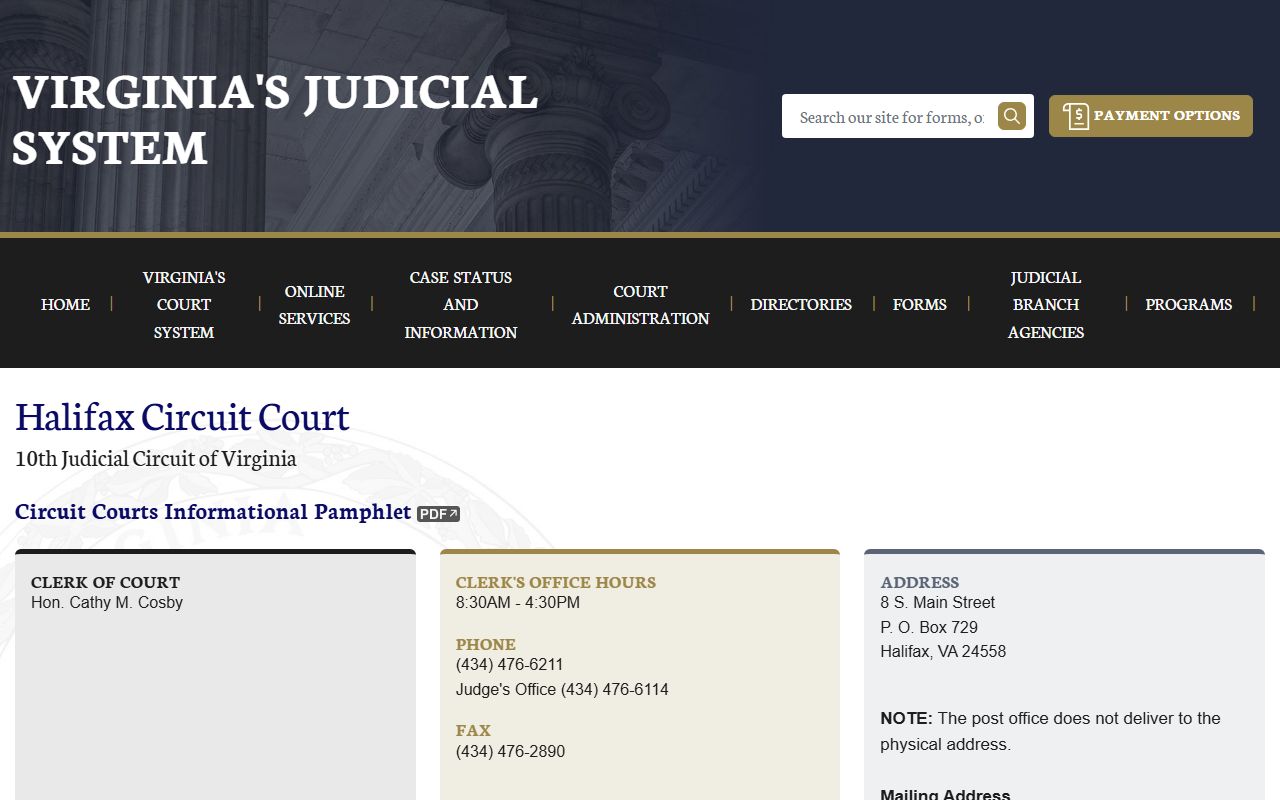
Check the official court page before your visit to confirm current hours. Courts sometimes have a daily cutoff time for accepting new recordings, so it helps to arrive early in the day if you plan to record a document.
Nearby Counties
Halifax County borders several Southside Virginia counties. Each has its own Circuit Court Clerk and deed record collection.