
Isle of Wight County Deed Records
Isle of Wight County deed records are maintained by the Circuit Court Clerk in Isle of Wight, the county seat of this 5th Judicial Circuit county in Hampton Roads. The clerk records and indexes all real estate instruments for land in the county, including warranty deeds, deeds of trust, quitclaim deeds, easements, and subdivision plats. Isle of Wight County has one of the longer land record histories in Virginia, with deed books dating back to the 17th century. You can search the deed index through Virginia's free SRA system, visit the courthouse in person, or request copies by mail. This page covers how to search, what gets recorded, fees, and where to find older documents.
Isle of Wight County Overview
Isle of Wight County Circuit Court Clerk
The Isle of Wight County Circuit Court Clerk's office is at the courthouse in Isle of Wight, the county seat. This office records all real estate instruments for land in the county, assigns deed book and page numbers, maintains public indexes, and provides copy services. Anyone can access the index at no charge. You can get the clerk's current phone number, mailing address, and office hours from the Isle of Wight County Circuit Court page on the Virginia courts website.
Under Virginia Code § 17.1-223, the clerk must maintain a general index of all recorded land instruments by both grantor and grantee name. Each entry in the index shows the instrument type, recording date, and the deed book and page where the full document is filed. Isle of Wight County is part of the 5th Judicial Circuit, which covers several counties and independent cities in the Hampton Roads region. The clerk staff can answer questions about document formatting, required forms, and whether a transfer is subject to the grantor's tax. They can also tell you whether the office accepts eRecording through an authorized vendor.
Isle of Wight County is located between the city of Suffolk and the counties of Southampton and Surry. Real estate in the county includes rural land, agricultural tracts, and residential development in the northern part of the county near Suffolk. The clerk's office handles the full range of recording types that go along with that variety. Certified copies of recorded instruments are available on request. A certified copy carries the court's seal and is accepted as legal evidence in proceedings where the authenticity of a document must be established.
Searching Isle of Wight Deed Records Online
Virginia's Secure Remote Access (SRA) system is the primary free online search tool for Isle of Wight County deed records. Search the grantor and grantee index by name at no cost. Results show the instrument type, recording date, and deed book and page number. Full document images beyond the index may require a paid subscription arranged through the clerk's office. Ask the clerk about image access options if you need more than just the index entries.
In-person access is available at the courthouse during regular business hours. Public terminals let you search the computerized index and locate records. Once you have the deed book and page number, staff can pull the record and make a copy. Bring the property owner's name or the county tax map parcel number. For rural properties in Isle of Wight, having the parcel number or a land description can help narrow down a search when a landowner's name is common in the county records. Title examiners working on Isle of Wight properties often use both the name index and parcel-based searches together.
For older records, the Library of Virginia holds microfilm copies of Isle of Wight County deed books dating back to the colonial era. Isle of Wight County was established in 1634, making it one of the original Virginia counties with a land record collection spanning nearly 400 years. The LVA catalog shows which deed books have been microfilmed or digitized. Researchers doing chain-of-title work on colonial-era land grants or antebellum plantations in this part of Virginia will almost certainly need to use the Library of Virginia in addition to the county courthouse.
What Gets Recorded in Isle of Wight County
Isle of Wight County deed books hold many types of real estate instruments. Warranty deeds are the standard tool for most property sales. They transfer title from seller to buyer with a full guarantee of ownership. Quitclaim deeds pass the grantor's interest without any warranty — used in family transfers, divorce settlements, and corrective deeds. Deeds of trust secure mortgage loans against Isle of Wight County real estate. When those loans are paid off, certificates of satisfaction or deeds of release clear the lien from the title record. Plat records document subdivision layouts and lot lines for new residential or commercial developments.
Other instruments in the deed books include easements for roads and utilities, restrictive covenants, judgment liens, mechanic's liens, and lis pendens notices. Agricultural and timber-related interests may also appear in the deed books for Isle of Wight's rural properties. Under Virginia Code § 55.1-407, recording in the correct county is what gives a deed its legal priority over competing unrecorded interests. An unrecorded deed is void against a later bona fide purchaser who records first. The Isle of Wight County deed books are the authoritative public record for land ownership in the county. If it is not in those books, it does not protect against third-party claims.
How to Record a Deed in Isle of Wight County
To record a deed in Isle of Wight County, bring the original signed and notarized document to the clerk's office. The document must meet the formatting requirements of Virginia Code § 17.1-252: a three-inch top margin on the first page, one-inch margins on all other sides, and all pages numbered. A cover sheet with the grantor and grantee names and parcel identification number is required under Virginia Code § 17.1-227. Social Security numbers must not appear anywhere in a recorded document.
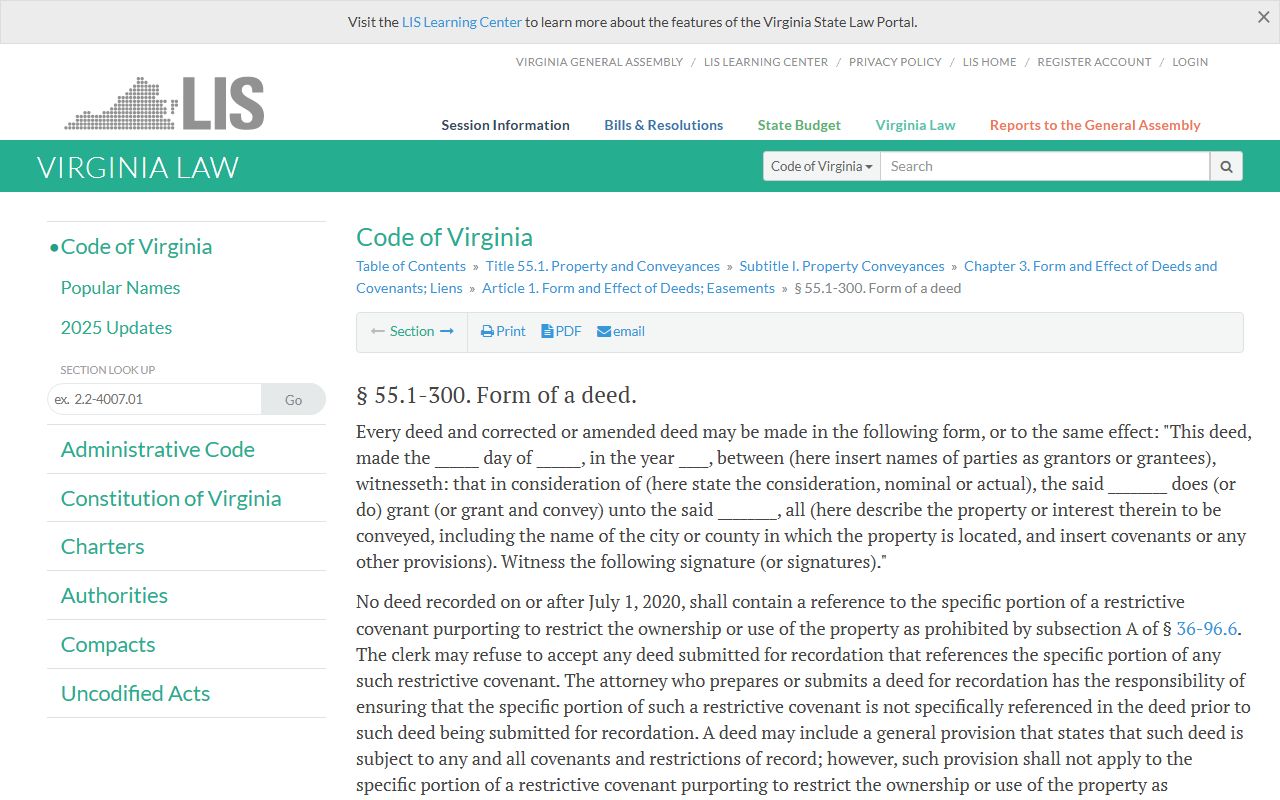
The deed must also comply with Virginia Code § 55.1-300, which sets out the required elements of a valid deed of conveyance: a clear property description and the names of all parties to the transfer. If a document fails to meet these requirements, the clerk can refuse to record it. Reviewing the deed for technical compliance before your visit prevents wasted trips. The clerk staff can answer questions about requirements but cannot advise you on how to draft or correct the deed.
Ask the Isle of Wight County clerk whether eRecording is accepted through an authorized vendor. Electronic recording lets professionals submit documents and fees digitally. If eRecording is not available, you can mail the original document with the correct fee and a self-addressed stamped envelope for the return of the recorded instrument after stamping.
Recording Fees and Taxes in Isle of Wight County
Recording fees in Isle of Wight County follow the statewide schedule under Virginia Code § 17.1-275. The base fee is $18 for documents of 10 pages or fewer. Documents from 11 to 30 pages cost $32. Anything with 31 or more pages is $52. Uncertified page copies are $0.50 each. Certified copies carry an additional fee set by the clerk. Call the office to confirm the current rate before your visit.
Most deed transfers are subject to the grantor's tax under Virginia Code § 58.1-801 at 25 cents per $100 of the consideration amount or fair market value. Some transfers qualify for a full or partial exemption under Virginia Code § 58.1-811. Exempt categories include gifts to close family members, transfers to or from a trust, and certain government or charitable conveyances. Bring documentation supporting the exemption claim if you believe your transaction qualifies.
Isle of Wight County may also collect a local grantor's tax on top of the state rate. Ask the clerk what the current combined rate is when you record. Deeds of trust and release instruments have their own fee schedules, so confirm the applicable fees if you are recording something other than a standard ownership transfer deed.
Isle of Wight County Land Records History
Isle of Wight County was established in 1634 as one of the original eight shires of Virginia. The county's deed records span nearly four centuries, making the collection one of the oldest continuous land record archives in the United States. Early deed books from the colonial and early national periods document land grants, transfers, and other instruments that are valuable to both title researchers and historians studying the development of the Virginia tidewater region.
The Library of Virginia holds microfilm and digital copies of many Isle of Wight County deed books. The LVA catalog is searchable online and shows which books are available remotely. For researchers tracing a chain of title back into the 18th or 19th century, or working on genealogical research tied to land in this part of Virginia, the Library of Virginia provides access to records that would otherwise require a trip to the Courthouse in Isle of Wight.
More recent deed records are in the clerk's electronic system and fully searchable through the SRA index. Ask the clerk what year the electronic index begins. For anything earlier, the physical deed books or LVA microfilm are the right resources. The transition from paper deed books to electronic recording happened at different times in different Virginia counties, and the clerk can tell you exactly where that line falls for Isle of Wight.
Getting Copies of Isle of Wight County Deed Records
Copies of Isle of Wight County deed records are available in person, by mail, or through the SRA system for indexed documents. In-person is the most straightforward method. Visit the clerk's office during business hours with the deed book and page number if you have it. Staff can locate the document and make a copy. Uncertified copies cost $0.50 per page. Certified copies require the court's seal and cost more — ask the clerk for the current fee.
Mail requests are accepted. Send a written letter to the Isle of Wight County Circuit Court Clerk with the grantor and grantee names, the approximate recording date, and a check or money order for the estimated fee. Include a self-addressed stamped envelope for the return mailing. Call the clerk's office first if your request is time-sensitive to confirm current processing times.
Under Virginia Code § 17.1-249, all recorded instruments must be made available to the public. No ownership interest is required. No reason needs to be given. Deed records are public. Title companies, attorneys, lenders, heirs, and researchers all have equal right to access any document in the public record.
The Isle of Wight County Circuit Court page has current contact details for the clerk's office, including phone number and address.
Check the court page before your visit to confirm current office hours. Courts often have a cutoff time for accepting new recordings each business day, so arriving early is the safer approach when you plan to record a document.
Nearby Counties
Isle of Wight County is in the 5th Judicial Circuit in Hampton Roads. These neighboring jurisdictions each maintain their own Circuit Court deed records.