
King and Queen County Deed Records
King and Queen County deed records are filed with the Circuit Court Clerk at the county courthouse in King and Queen Court House, Virginia. The office holds land conveyances, plat records, deeds of trust, and other real property instruments dating back to the county's formation in the 17th century. You can search records in person at the clerk's office, request copies by mail, or use the state's online index tools to find grantor and grantee information without making the trip to the courthouse.
King and Queen County Overview
Circuit Court Clerk's Office
The Circuit Court Clerk for King and Queen County is the official keeper of all land records. The clerk records, indexes, and stores deeds, plats, deeds of trust, and related instruments for property located in the county. When you submit a deed, staff verify that it meets Virginia's formatting requirements, collect fees and taxes, and return the original document after recording.
The King and Queen County Circuit Court is part of Virginia's 9th Judicial Circuit. The courthouse is located in the small unincorporated community known as King and Queen Court House. Contact the clerk's office directly for current hours and mailing address. For mailed submissions, include a self-addressed stamped envelope so your original documents can be returned after recording.
Staff can assist with locating records and explaining what types of documents are on file. They cannot provide legal advice or help interpret deed language.
Searching King and Queen Deed Records Online
Virginia provides a free online index through the Supreme Court of Virginia's SRA system. You can search grantor and grantee indexes for King and Queen County without visiting the courthouse. Results show the parties' names, document type, recording date, and the deed book and page number where the document is stored. Full document images may require a subscription or an in-person visit.
For older land records, the Library of Virginia holds deed books and microfilm collections from many early Virginia counties. King and Queen County has permanent land records from its formation, and some materials may be available through LVA's digital collections or by visiting their Richmond reading room.
The clerk's office maintains both computerized indexes for more recent records and older bound deed books for historical searches. Staff can point you to the right deed book and page if you have approximate dates or party names.
What Gets Recorded in King and Queen County
The clerk records all instruments that affect real property in King and Queen County. Common deed types include warranty deeds, quitclaim deeds, deeds of trust, and mortgages. The office also records certificates of satisfaction when loans are paid off, easement agreements, subdivision plats and surveys, powers of attorney used in real estate closings, and judgment liens on property.
UCC filings that affect real estate are also filed with the Circuit Court Clerk. Lis pendens notices, condominium declarations, and other instruments that create or release interests in land must all be recorded here to be effective against third parties.
Under Virginia Code § 55.1-407, an unrecorded deed is void against a subsequent bona fide purchaser who records first. Recording promptly is the only way to protect your ownership interest. Virginia uses a race-notice recording system, meaning the first party to record with proper notice wins.
How to Record a Deed in King and Queen County
You must submit the original deed with original signatures and notarization. Photocopies are not accepted for recording. Pages must be numbered, and under Virginia Code § 55.1-300, the grantor's and grantee's surnames must appear in capital letters or be underscored in the first clause of the document.
The tax map parcel ID must appear on the first page of the deed, as required by Virginia Code § 17.1-252. Social security numbers must be removed before filing per § 17.1-227. A cover sheet is required under § 17.1-227.1. Bring or enclose a self-addressed stamped envelope so originals can be returned to you.
Some Virginia clerks accept eRecording through third-party services. Check with the King and Queen County clerk's office to find out if that option is available. Title companies and settlement agents most often use this method.
Recording Fees and Taxes
King and Queen County follows the statewide fee schedule under Virginia Code § 17.1-275. The base recording fee is $18 for documents of 10 pages or fewer. Documents of 11 to 30 pages cost $32. Any document over 30 pages costs $52. A portion of each fee goes to the Library of Virginia for records preservation.
Most deeds are also subject to the state recordation tax. Under Virginia Code § 58.1-801, the rate is 25 cents per $100 of the purchase price or fair market value, whichever is greater. Some transfers qualify for an exemption under § 58.1-811, including certain family transfers and transfers to government entities.
Copies of recorded documents cost $0.50 per page. Certified copies carry an additional fee. Confirm the current amount with the clerk's office before submitting your request.
Historical Land Records in King and Queen County
King and Queen County was formed in 1691, giving it one of the longer deed record histories among Virginia counties. Land conveyances from the late 17th and 18th centuries are part of the county's permanent record holdings. These older records document early colonial land grants, transfers between planters, and the gradual settlement of the Middle Peninsula region.
Researchers doing title work or genealogical searches may need to consult both the courthouse and the Library of Virginia. LVA holds microfilm and digitized materials for many early Virginia land records, and their catalog can help you determine which deed books cover a given time period. For recent records, the SRA online index is the fastest way to start your search.
The image below shows the Virginia circuit court directory, which provides contact information and links for all Virginia circuit courts including King and Queen County.
Visit the Virginia Circuit Court Directory to find clerk contact details, hours, and online access options for King and Queen County and every other Virginia circuit.
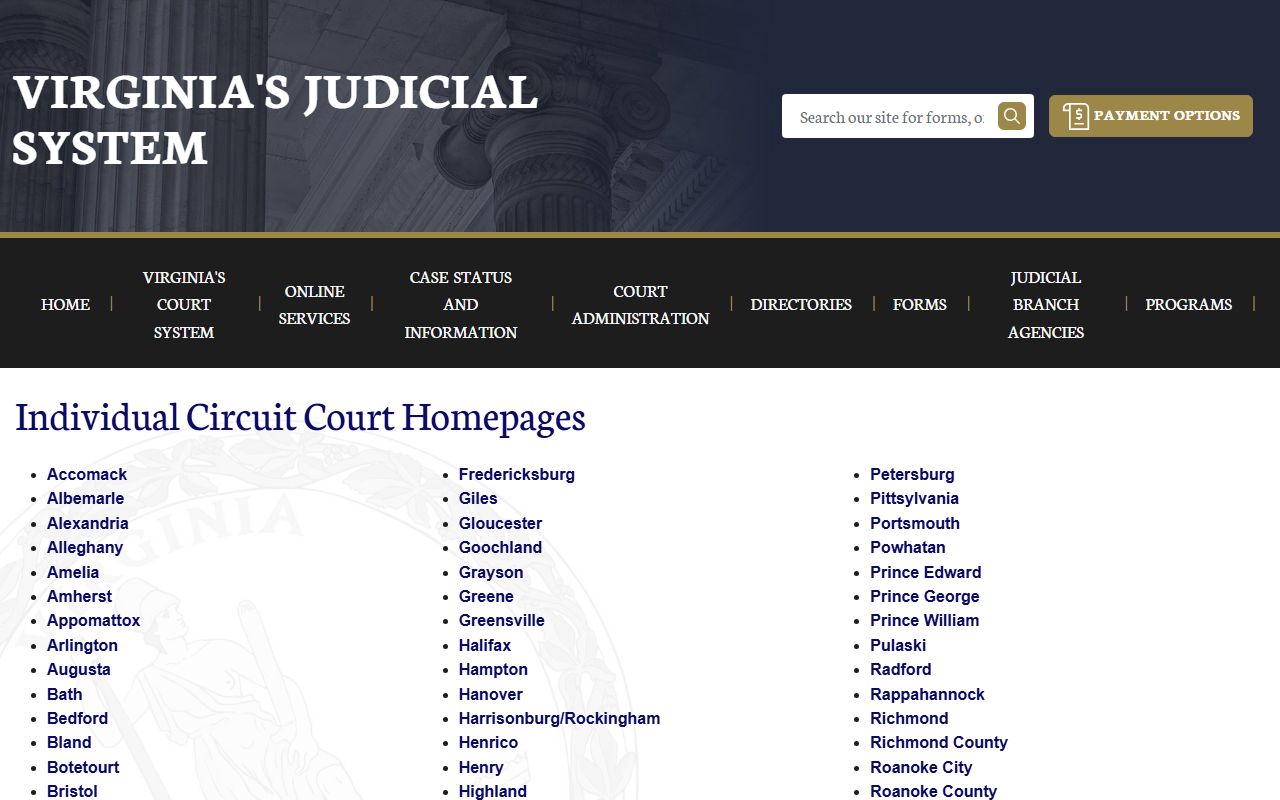
Use this resource to confirm current clerk information and links to online deed record searches for King and Queen County.
Getting Copies of Recorded Deeds
Copies are available in person at the Circuit Court Clerk's office. Bring the deed book and page number if you have it, or use the grantor/grantee index to look up the document first. Copies cost $0.50 per page. Certified copies are available for an additional fee and are often needed for legal proceedings or lender requirements.
Mail requests are accepted. Include the grantor or grantee name, approximate date of recording, and a description of the property. Enclose payment and a self-addressed stamped envelope. Call the clerk's office ahead of time if you have a tight deadline.
For very old deed books, you may need to contact the Library of Virginia directly. They hold original deed books for many early Virginia counties, and some materials are available online through their digital collections.
Nearby Counties
Property deed records for neighboring counties are maintained by each county's Circuit Court Clerk. The counties below share borders with King and Queen County.