
King William County Deed Records
King William County deed records are kept by the Circuit Court Clerk in King William, the county seat of this 9th Judicial Circuit county on the Middle Peninsula of Virginia. The clerk records and indexes all real estate instruments for land in the county, including warranty deeds, deeds of trust, quitclaim deeds, plats, and easements. King William County has a long land record history, with deed books going back to the early 18th century. You can search the deed index through Virginia's free SRA system, visit the courthouse in person, or request copies by mail. This page explains the search process, what gets recorded, current fees, and how to access older historical records.
King William County Overview
King William County Circuit Court Clerk
The King William County Circuit Court Clerk's office is located at the courthouse in King William, Virginia. This office records all real estate instruments filed for land in the county, maintains the public deed index, assigns deed book and page numbers, and provides copy services. The index is open to anyone free of charge. You can find the clerk's current phone number, mailing address, and office hours from the King William County Circuit Court page on the Virginia courts website.
Under Virginia Code § 17.1-223, the clerk must maintain a general index of all recorded land instruments by both grantor and grantee name. Each entry shows the instrument type, recording date, and deed book and page where the full document is stored. King William County is part of the 9th Judicial Circuit, which covers several Middle Peninsula counties. The clerk staff can answer questions about document requirements and whether a transaction is subject to the grantor's tax. Because this is a smaller rural county, calling ahead before visiting is a smart move to confirm hours and staff availability.
King William County sits between the Pamunkey and Mattaponi rivers on the Middle Peninsula, east of Hanover County. Real estate in the county includes rural tracts, farmland, waterfront properties, and suburban residential development in the western part of the county closer to Hanover. The deed books reflect that range. Certified copies of any recorded instrument are available on request, with the court's seal, and are accepted in legal proceedings as proof of the recorded document's contents.
Searching King William County Deed Records Online
Virginia's Secure Remote Access (SRA) system is the primary free online search tool for King William County deed records. Search the grantor and grantee index by name at no cost from any device with internet access. Results include the instrument type, recording date, and deed book and page number. Full document images beyond the index entry may require a paid subscription set up through the clerk. Contact the King William County clerk to ask whether image access is available and how to set it up.
In-person access is available at the courthouse in King William during regular business hours. Public terminals let you search the computerized index yourself. Staff can pull the deed book or make a copy once you have identified the record by book and page number. Bring the property owner's name or the county tax map parcel number. For rural properties in King William, the parcel number is often the most reliable way to find the right records quickly, especially when a landowner's name is common in the index.
For older records not in the clerk's electronic system, the Library of Virginia holds microfilm and digitized copies of early King William County deed books. The county was formed in 1702, giving it more than three centuries of land records. The LVA catalog shows which deed books are available in microfilm or digital format. Researchers doing chain-of-title work or family history research in the Middle Peninsula will often need to use the Library of Virginia for records from the 18th and 19th centuries.
What Gets Recorded in King William County
King William County deed books hold a range of real estate instruments. Warranty deeds are the standard tool for most property transfers. They convey title with a full ownership guarantee. Quitclaim deeds pass the grantor's interest without any warranty and appear in family transfers, divorce settlements, and situations where a corrective deed is needed. Deeds of trust secure mortgage loans against King William County real estate. When those loans are paid, certificates of satisfaction or deeds of release clear the lien from the title record. Plat records document lot boundaries and road dedications for subdivisions created in the county.
Other instruments in the deed books include easements for roads, utilities, and driveways; restrictive covenants running with the land; judgment liens; mechanic's liens; and lis pendens notices filed to put buyers on notice of pending litigation over a specific property. Waterfront easements and riparian rights documents may also appear in the deed books for properties along the Pamunkey and Mattaponi rivers. Under Virginia Code § 55.1-407, recording in the correct county is what gives a deed its legal priority over competing interests. An unrecorded deed is void against a bona fide purchaser who records later. The King William County deed books are the authoritative public record of who holds title to land in the county.
How to Record a Deed in King William County
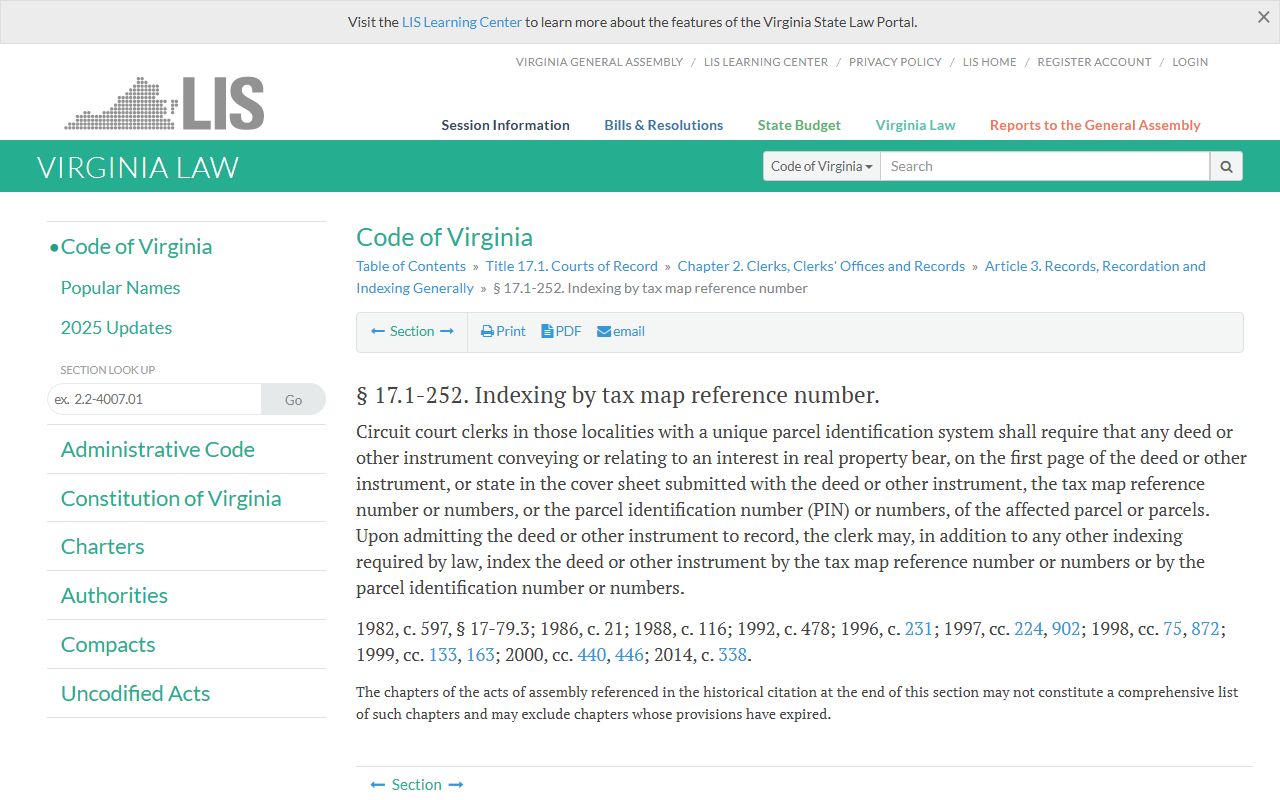
To record a deed in King William County, bring the original signed and notarized document to the clerk's office. The document must meet the formatting standards in Virginia Code § 17.1-252: a three-inch top margin on the first page, one-inch margins on all other sides, and all pages numbered. A cover sheet listing the grantor and grantee names and parcel identification number is required under Virginia Code § 17.1-227. No Social Security numbers may appear in a recorded document.
The deed must also comply with Virginia Code § 55.1-300, which specifies what a valid deed of conveyance must contain: a clear property description and the names of all parties. If the document does not meet these requirements, the clerk can decline to record it. Reviewing the deed before the trip to King William is worth doing to avoid a second visit. The clerk can answer questions about technical requirements but cannot give legal advice on how to draft or correct the deed.
Ask the clerk whether King William County accepts eRecording through an authorized vendor. Electronic recording may be useful for real estate professionals handling multiple closings who prefer not to travel to the courthouse for each one. If eRecording is not available, mail-in submission is also accepted. Send the original document with the correct fee and a self-addressed stamped envelope for the return of the recorded instrument.
Recording Fees and Taxes in King William County
Recording fees in King William County follow the statewide schedule under Virginia Code § 17.1-275. The base fee is $18 for documents of 10 pages or fewer. Documents from 11 to 30 pages cost $32. Anything with 31 or more pages is $52. Uncertified page copies are $0.50 each. Certified copies carry an additional fee set by the clerk. Call before your visit to confirm the current certified copy rate.
Most deed transfers are subject to the grantor's tax under Virginia Code § 58.1-801 at 25 cents per $100 of the consideration amount or fair market value. Some transfers qualify for an exemption under Virginia Code § 58.1-811. Exempt transfers include gifts between close family members, transfers involving trusts, and certain government or charitable conveyances. If you believe the transfer qualifies for an exemption, bring documentation when you go to record.
King William County may also levy a local grantor's tax on top of the state rate. Ask the clerk what the combined current rate is when you record. Deeds of trust and release instruments have their own fee structures under the statewide schedule, so confirm the applicable fees if you are recording something other than a standard ownership transfer deed.
King William County Land Records History
King William County was formed in 1702 from King and Queen County. The county's land records span more than three centuries and document land ownership on the Middle Peninsula through the colonial, revolutionary, antebellum, and modern periods. Early deed books have been preserved and microfilmed. Researchers tracing title or family history in this part of Virginia often encounter King William County records as part of their work.
The Library of Virginia holds microfilm and digitized copies of early King William County deed books. The LVA catalog is searchable online and shows which books are available in each format. For researchers working on a chain of title that goes back to the 18th or 19th century, the Library of Virginia is an essential resource. Some early deed books also contain other legal instruments that were routinely recorded in the same books during the colonial and early federal periods.
More recent records are in the clerk's digital system and searchable through the SRA index. Ask the clerk what year the electronic index begins so you know when older research tools become necessary. For anything earlier than the electronic cutoff, physical deed books at the King William courthouse or microfilm at the Library of Virginia are the right starting points.
Getting Copies of King William County Deed Records
Copies of King William County deed records are available in person at the courthouse, by mail, or through the SRA system for index information. In-person access is usually the most efficient option. Visit the clerk's office in King William with the deed book and page number if you have it. Staff can pull the record and make a copy. Uncertified copies cost $0.50 per page. Certified copies require the court's seal and cost more — ask the clerk for the current fee before your visit.
Mail requests are accepted. Write to the King William County Circuit Court Clerk with the grantor and grantee names, approximate recording date or book and page number, and a check or money order for the estimated fee. Include a self-addressed stamped envelope for the return. Processing times vary by current office workload. Calling the clerk ahead of time to confirm turnaround times is useful when you have a deadline.
Under Virginia Code § 17.1-249, clerks must make all recorded instruments available to the public. No ownership interest is required, and no explanation is needed. Deed records are public documents open to any person who wants to look them up. Title companies, lenders, attorneys, heirs, and researchers all use these records, and the law ensures equal access for everyone.
The King William County Circuit Court page has current contact information for the clerk's office, including phone number and address.
Check the court page before visiting to confirm current office hours. Courts often have a daily cutoff for accepting new document recordings, so arriving early in the day is the practical approach when you need to record something.
Nearby Counties
King William County is in the 9th Judicial Circuit on Virginia's Middle Peninsula. These neighboring counties each maintain their own Circuit Court deed records.